Sustainable, smart ventilation in multi-storey housing
Text Lieke BousemaImage Barcol-Air en Claudia Terreehorst Fotografie

An innovative complete ventilation concept for multi-storey housing. Sustainable, smart and comfortable. Barcol-Air, based in Purmerend, has been making waves in the multi-storey housing sector with its CERA complete ventilation concept since 2018. In this article, Commercial Manager Lars Wiersma explains the system and all its benefits. “An f-control value of 0.4 is always a great opener!” he laughs, before telling us more about the unique technology, which has already been used in many exceptional projects.
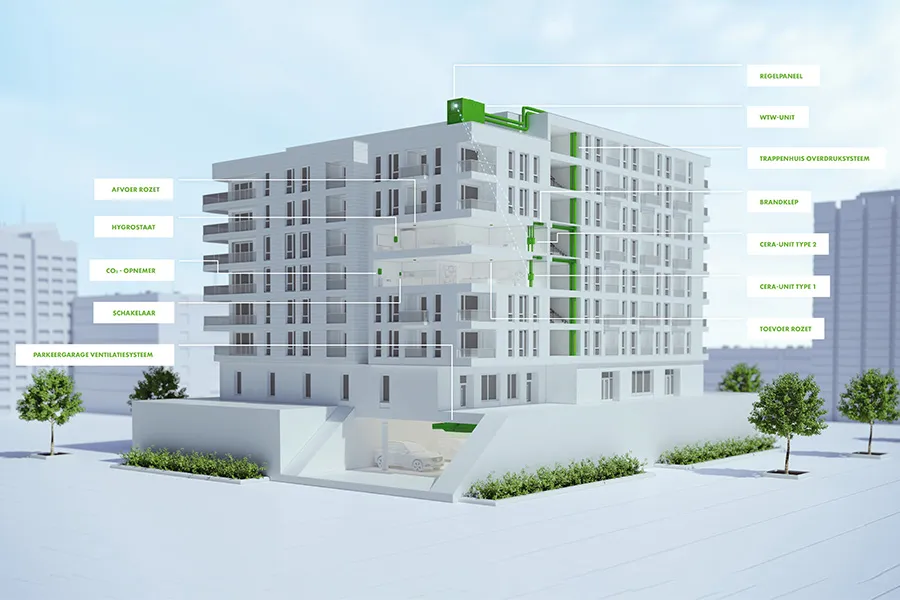
“CERA stands for Central Energy Recovery Airflow. It is a unique central ventilation system that we developed together with consultancy Hiensch Engineering,” he explains. “For several years now, tighter legislation and regulations have required new-build apartments to be fitted with demand-controlled ventilation systems. The CERA system offers the perfect solution in this context.”
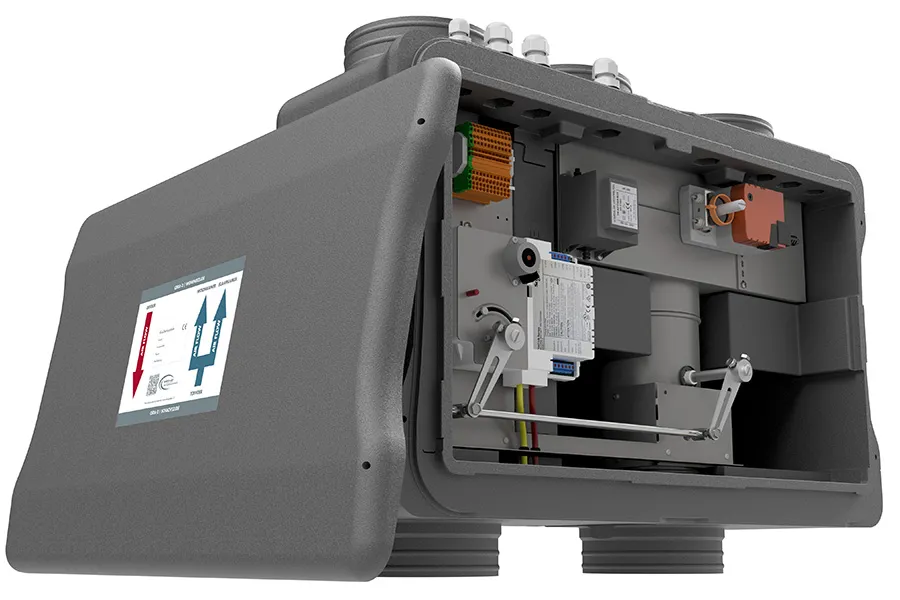
The system works in a straightforward way: the CERA unit installed in each apartment controls the airflow for both supply and extract. CO2 sensors installed in the various rooms ensure that indoor air is refreshed sufficiently. In addition, boost switches and humidistats can be used to temporarily run the system at maximum capacity. The filters, fan and heat exchanger are integrated into a central air handling unit (heat recovery unit) on the roof or in the plant room. The result is an exceptionally quiet, maintenance-free residential installation, with significantly lower energy consumption across the ventilation system as a whole.
The most energy-efficient system of its kind
“BENG calculations are an important part of the permit application process for new residential buildings,” Wiersma explains. “The CERA system contributes to this and can be configured as a 1- or 2-zone system. The 2-zone system achieves an f-control score of 0.4. Up to six CO2 sensors can be connected in separate rooms.”
The CERA system is registered with Stichting Bureau Controle en Registratie Gelijkwaardigheid (BCRG) and is included in the well-known databases and libraries. This makes it easy to produce BENG calculations using Uniec 3, VABI or BINK. Based on its airflow control factor, CERA is currently the most energy-efficient system of its kind.
Savings of 30-50 per cent
According to Wiersma, one major advantage of central ventilation is the simultaneity factor. “Because the CERA units in the apartments do not have fans, and the fans in the central heat recovery unit run continuously at part load, savings of 30-50 per cent compared with conventional systems are possible. Monitoring data from completed projects even shows that the system performs more efficiently than expected!”
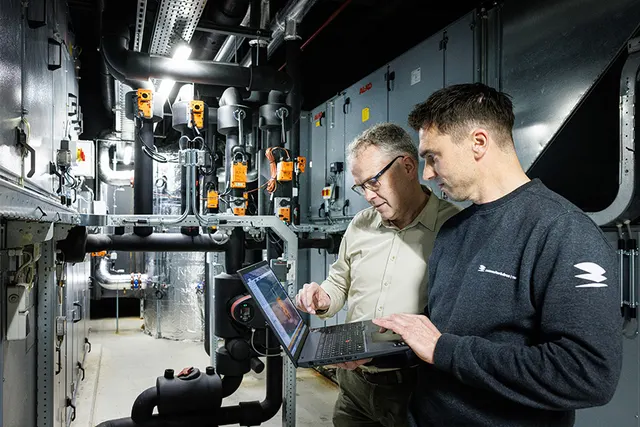
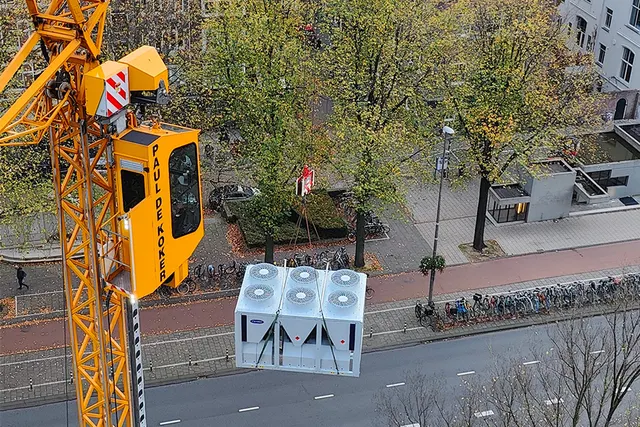
At the end of 2022, Rosenberg became part of HC Groep, which also includes Barcol-Air. This has created new synergies. “The Rosenberg air handling units work particularly well with the CERA system at part load,” says Wiersma. “When air flows pass through a heat recovery unit, the units are highly efficient at transferring energy. In winter, for example, all the energy (heat) in the indoor air can be used to preheat the cold outdoor air. In summer, the process works in exactly the opposite way.”
Successful project completions
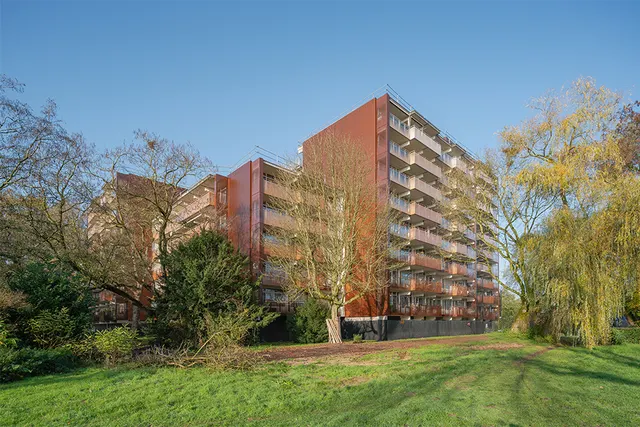
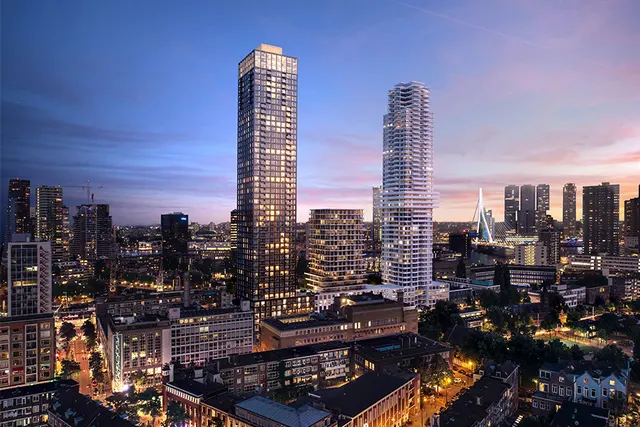
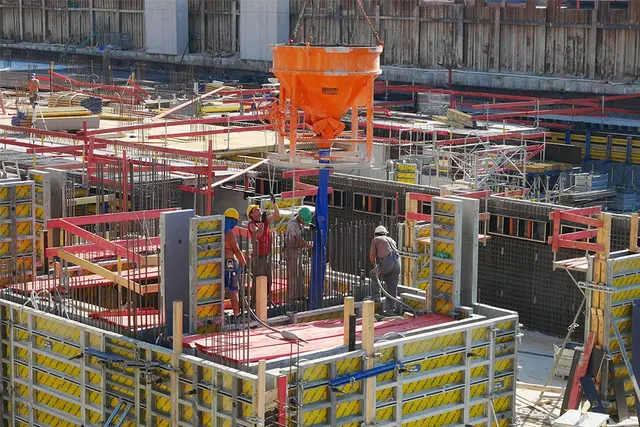
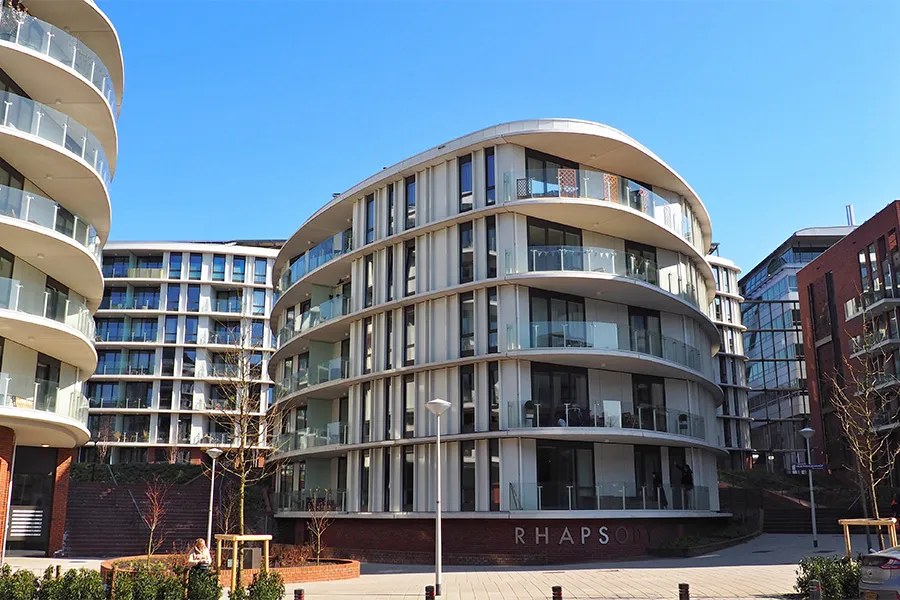
There are hardly any suitable building sites left within the boundaries of our major cities, so buildings have to grow upwards. Residential towers with several hundred homes are no longer the exception. CERA has become an established name in multi-storey housing ventilation. “We have completed many impressive projects using our CERA system,” says Wiersma with understandable pride. “Large projects such as Rhapsody in Amsterdam and De Zalmhaven in Rotterdam, the tallest residential tower in the Benelux, feature in our portfolio, but we are increasingly involved in smaller projects too.”
Commercially attractive too
“Our CERA system was developed, and continues to evolve, with project developers, installers, building managers and residents in mind,” says Wiersma. “Alongside energy performance, the considerations include initial investment costs, Total Cost of Ownership (TCO), ease of installation and maintenance, and of course a healthy indoor climate and resident comfort.” Calculations show that, for CERA, the break-even point on initial investment compared with decentralised systems is around 30 apartments per residential tower; for TCO, it is as low as around 25. “That sounds about right,” Wiersma confirms. “If EIA or SVVE subsidies are available, the threshold may be a little lower.” Choosing an individual or decentralised ventilation unit with an outdoor air connection, fan, filter and heat exchanger for each apartment involves considerable installation work, time and cost. As well as the risk of noise complaints, these ventilation units also require annual maintenance. According to Wiersma, the CERA system effectively addresses these challenges. “It is an extremely quiet system that also significantly reduces installation time and maintenance costs. Maintenance contractors also appreciate not having to arrange routine maintenance visits with residents on a regular basis. With no fans or filters in the apartments, visits inside residents’ homes are kept to a minimum.”
The CERA units are supplied ready to plug in. Each unit carries a sticker showing the correct building and apartment number, and is pre-programmed for each project and apartment based on the required airflows, the relevant connection diagram and the controls specification.
Sharing experience
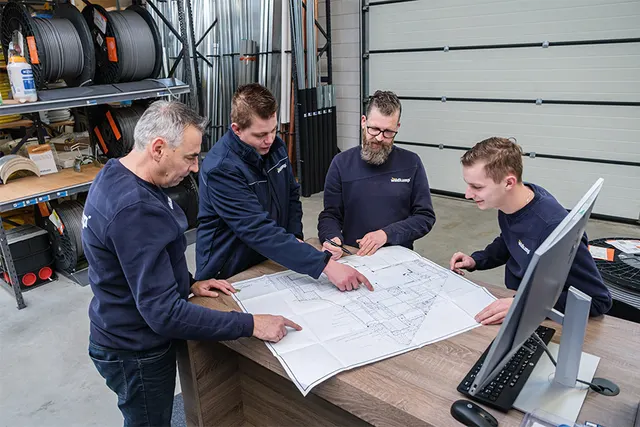
Much of the CERA system’s success stems from the company’s involvement at every stage of a project. Wiersma gives an example of the support provided to installers. “We always provide input on both the commercial and technical sides,” he explains. “That is something we are used to from commercial projects, which we have been involved in since 1983. We are now keen to bring the same approach to housing. Of course, we make sure our proposal meets the specification, but, more importantly, because CERA is a relatively new concept, we run sessions on positioning all the components, commissioning and connecting the system. We also actively share experience of issues installers can or should take into account.”
Central ventilation systems for multi-storey housing in general, and CERA in particular, are gaining traction as legislation tightens and user expectations rise. By listening closely to its stakeholders, Barcol-Air helps ensure projects are successful and is looking forward to future developments.
Sustainable, safe and monitorable
Barcol-Air offers CERA units with capacities of up to 700 m3/h, but as more smaller residential units are built, demand for units of up to 250 m3/h is growing faster. “That is why our smallest 1- and 2-zone versions are made from EPP, making them easy to handle and enabling sustainable production,” says Wiersma. “We are seeing growing demand for integration with building management systems. Within HC Groep, we work closely with HC RT, our controls colleagues. They can provide system visualisation and solutions for monitoring energy performance, maintenance intervals for the central heat recovery unit and any fault notifications. This often delivers substantial savings in building management costs for owners. We also keep a close eye on developments in smoke and fire safety guidance for ventilation systems, and expect to bring an application to market soon that will integrate seamlessly with the CERA system.”
Double anniversary
2023 is a special year for Barcol-Air. The distributor and manufacturer of high-quality air distribution components and VAV systems is celebrating its 40th anniversary, while also marking 5 years of ventilation with the CERA system. The company has been part of HC Groep since 2006. The group brings together all disciplines in indoor climate technology, from car park ventilation to chilled ceilings, air handling units and building automation.
Question about this story? Ask your question
Keep following this
Get an email when a new story is published. No account needed.
- ThemeHealthy indoor air
- SubjectSustainable construction