











Tackle water shortages with rainwater
Text Wildkamp en Lieke BousemaImage Wildkamp
In a world where water is scarce, it seems unthinkable that we flush our toilets with valuable mains water. But unfortunately, the reality is quite the opposite. Did you know that in the Netherlands we use more than 100 litres of drinking water per person per day? And that we flush more than 50% of it down the toilet or use it for the washing machine and/or garden? Uses that do not require expensive drinking-water quality at all! “Wasting drinking water is incredibly wasteful and unnecessary,” says Sander Schonewille, product specialist at Wildkamp. “Greywater and rainwater can be recycled perfectly well. This is not only better for the environment, it also saves significant amounts of water, up to 60%. Thanks to Wildkamp’s expertise and extensive product range, these systems are also easy to install.”
Water shortages loom
Water consumption is rising exponentially. Research by RIVM shows that major drinking water shortages will arise by 2030. An additional 102 million cubic metres of water will need to be extracted, but the capacity to do so is not available. “Water shortages are already a regional issue. Our drinking water network simply cannot meet rising demand. Without measures, this will cause problems for many businesses,” says Schonewille. “We are already seeing businesses, such as holiday parks and campsites, unable to expand because the water company cannot guarantee sufficient capacity during peak periods. Drinking water is also forecast to become 30% more expensive in the coming years. Water companies pass these costs on to major consumers. For more and more businesses, this is reason enough to switch to rainwater recycling.”
Reuse instead of discharge
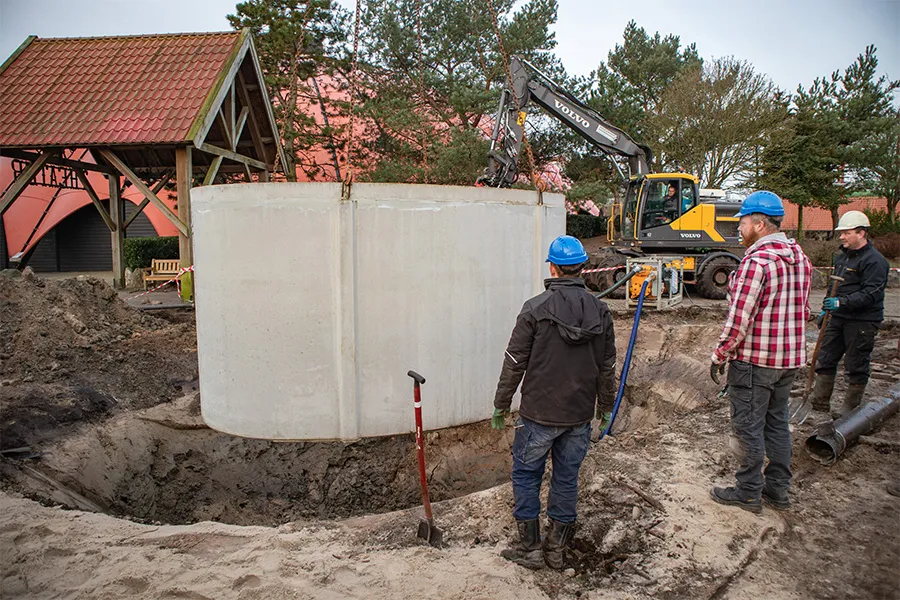
Belgium has already tightened its rainwater regulations. Larger rainwater tanks and increased infiltration are among the many measures the government is introducing to better protect our southern neighbours against shortages and drought. Collecting and reusing rainwater is therefore the rule, while discharging it is the exception. “The Netherlands is also making progress in this area,” says Schonewille. “The government aims to reduce drinking water consumption by 20% by 2035. The largest water companies in the Netherlands have already committed to this target.”
Benefits
Using filtered rainwater for the washing machine, garden and/or toilet flushing can significantly reduce consumption of valuable drinking water. “Wildkamp’s rainwater systems make this possible safely and reliably,” says Schonewille. “Rainwater contains no limescale, making it even better for washing than drinking water. The system collects and filters the rainwater, then pumps it back to the points of use on the property.” In many municipalities, residents are already required to discharge rainwater on their own property rather than into the sewer. “A rainwater system lets you reuse rainwater while also reducing the load on the sewer.”
Intelligent rainwater system
Wildkamp’s rainwater systems feature unique control technology. For example, the intelligent rainwater management technology ensures that the pump automatically switches to mains water if the rainwater tank is at risk of running empty. “It is essentially a smart control system for rainwater systems,” says Schonewille. “When the rainwater tank is empty, it is not topped up with expensive mains water. Instead, the irrigation system automatically switches to mains water without filling the rainwater tank. After rainfall, the system automatically switches back to rainwater. This smart technology therefore delivers greater water savings and ensures greater operational reliability.”
Rainwater reuse for businesses
Rainwater systems are suitable not only for private homes, but also for apartment buildings, schools, hospitality venues, campsites, holiday parks, public buildings and sports centres. Collecting and using rainwater is particularly useful there for flushing toilets, for example. Businesses can also use rainwater effectively as process water.
Product range
Wildkamp offers an extensive range of rainwater reuse systems, from fully equipped rainwater tanks to KIWA-approved pump systems, developed to a high standard in terms of storage, filtration, pump technology, safety and ease of use. “The filtration technology used ensures users benefit from the best water quality,” says Schonewille. “They also get highly professional systems featuring proven technology that has been in use for more than 20 years.”
Rainwater reuse requires a tailored approach. Tank capacity, for example, depends on demand. Wildkamp’s specialists will be happy to help you design an effective rainwater reuse system.
A business enquiry for Wildkamp? Get in touch
Companies in this story

Keep following this
Get an email when a new story is published. No account needed.
- ThemeFuture-proof water and sanitary systems
- SubjectGeneral
- CompanyWildkamp







