











The importance of getting expansion right
Text Lieke BousemaImage Spirotech
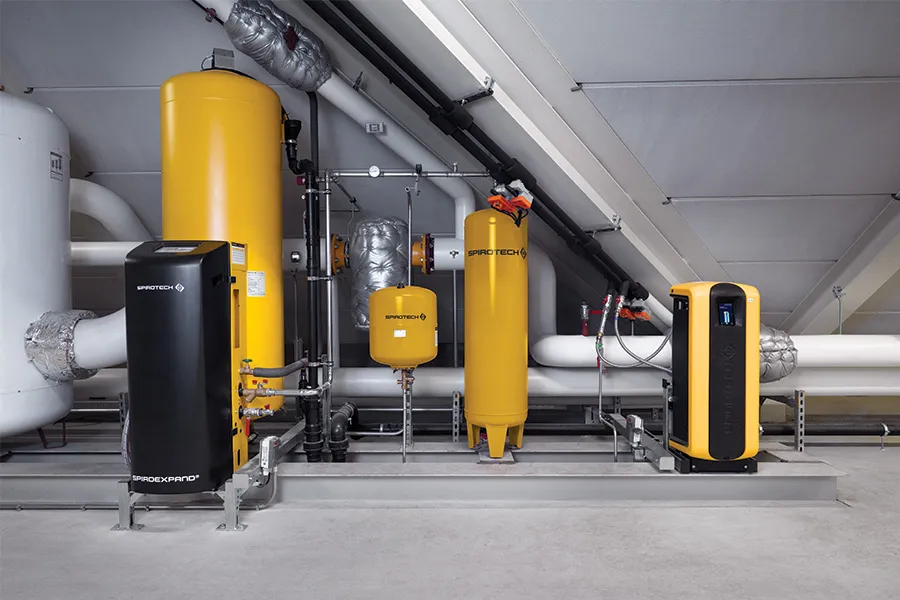
Pressurised, closed heating and cooling systems need an expansion system to accommodate the expansion of water, for example, as it heats up or cools down. “If pressure does not build up optimally in the installation, this can negatively affect the performance and service life of the entire system,” says Martijn Worst, Area Sales Manager Utilities & Industry at Spirotech. “That is why it is important to invest in a high-quality expansion system that is precisely tailored to its users’ heating and cooling requirements.”
Under the SpiroExpand name, Spirotech offers a comprehensive range of expansion vessels, pressurisation units and accessories for closed heating and cooling systems. The range runs from simple solutions to highly complex systems, with a maximum operating pressure of 1 to 25 bar and capacities from 4 up to 10,000 litres (larger sizes are available on request).
Expansion vessel or pressurisation unit
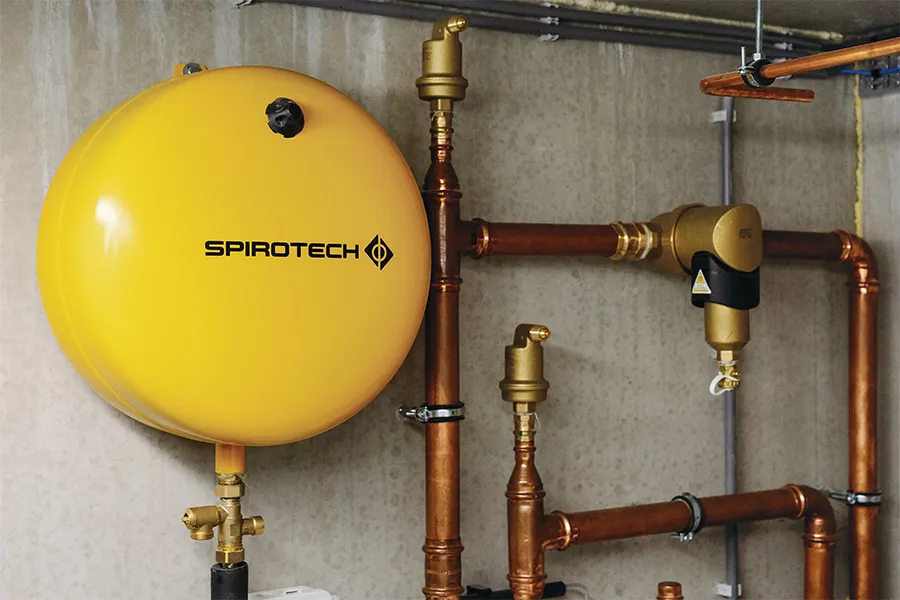
“The main difference between an expansion vessel and a pressurisation unit is that an expansion vessel passively separates the water and gas compartments with a diaphragm, whereas a pressurisation unit is an actively controlled system that uses pumps and valves to add or remove water to regulate the pressure,” explains Worst. “Expansion vessels are ideally suited to homes, offices, schools and other smaller buildings. For larger heating or cooling systems of around 1,000 litres or more, and for more complex systems with significant pressure differences, we recommend using a pressurisation system to regulate the pressure. Our pressurisation units are designed to maintain constant system pressure, regardless of any temperature fluctuations. They also come with a standard basic degassing function, which reduces the risk of corrosion and ensures safe, efficient operation of the entire heating or cooling system.”
Compact and efficient
“Large buildings often have large heating and cooling systems with a high fluid capacity,” says Worst. “Accommodating the expansion would require enormous expansion vessels. In addition to the fluid, enough space must be available for the air (or an inert gas such as nitrogen) that provides the required pre-charge pressure.” For this reason, a 500-litre vessel, for example, holds ‘only’ 300 litres of water. “The remaining 200 litres are used for the air pressure.” This can present challenges in large installations. “In an average home, an 18-litre expansion vessel is often sufficient, and when combined with a heat pump this can even be reduced to 8 or 12 litres. Large offices and university buildings, on the other hand, often need expansion vessels of 2,000, 5,000 or even 10,000 litres. This means enormous dimensions and weights, which will not fit everywhere in a building. Given the structural load and the cost per square metre of floor space, a pressurisation unit is the better choice.”
In this situation, choosing a pump-controlled rather than a compressor-controlled pressurisation unit means no air capacity is required, explains Worst. “The entire tank capacity can therefore be used as expansion volume. As a result, the pressurisation unit can be more compact and fitted more easily into the plant room. This is ideal for projects where floor space needs to be used as efficiently as possible.”
Very quiet, accurate and safe
Spirotech manufactures and supplies only pump-controlled pressurisation units, which operate considerably more quietly than their compressor-controlled counterparts. “Our pump-controlled pressurisation units are very quiet,” emphasises Worst. “They are also much more accurate. Because our systems are fully modular, they can be installed on a plug-and-play basis, both hydraulically and electrically, keeping installation time relatively short.” A mechanical valve regulates the system pressure. “One innovation is that we use spring-loaded valves instead of electrically actuated ones, so the installation remains operational even in the event of a power failure. This helps ensure system safety.”
Automatic, controlled top-up
A major advantage of a pressurisation unit is that the heating or cooling system is topped up automatically and in a controlled manner, explains Worst. “In this case, the pressurisation unit is connected to the drinking water supply. If the pressure drops because there is too little water in the system, the unit can automatically top it up to the correct pressure. There is no need for a maintenance engineer to visit.”
Monitoring and fault response
SpiroExpand pressurisation units have a digital control panel that is available in all languages and is intuitive to operate. The units can also be connected to the building management system, if required, enabling remote monitoring. “Any deviations or faults are reported automatically, allowing the right action to be taken straight away. This benefits not only comfort but also the service life of the system.”
Longer service life, favourable TCO
An expansion vessel has an average service life of seven years, depending on the quality of the rubber, system stability and level of maintenance. A pressurisation unit, by contrast, can last 15 to 20 years, says Worst. “Combined with the other benefits, an investment in a pressurisation unit pays for itself many times over.”
A business enquiry for Spirotech? Get in touch
Companies in this story

Keep following this
Get an email when a new story is published. No account needed.
- SubjectGeneral
- CompanySpirotech







