











VRF system delivers comfort and energy benefits at Sparta’s training complex
Text Alklima en Lieke BousemaImage Alklima
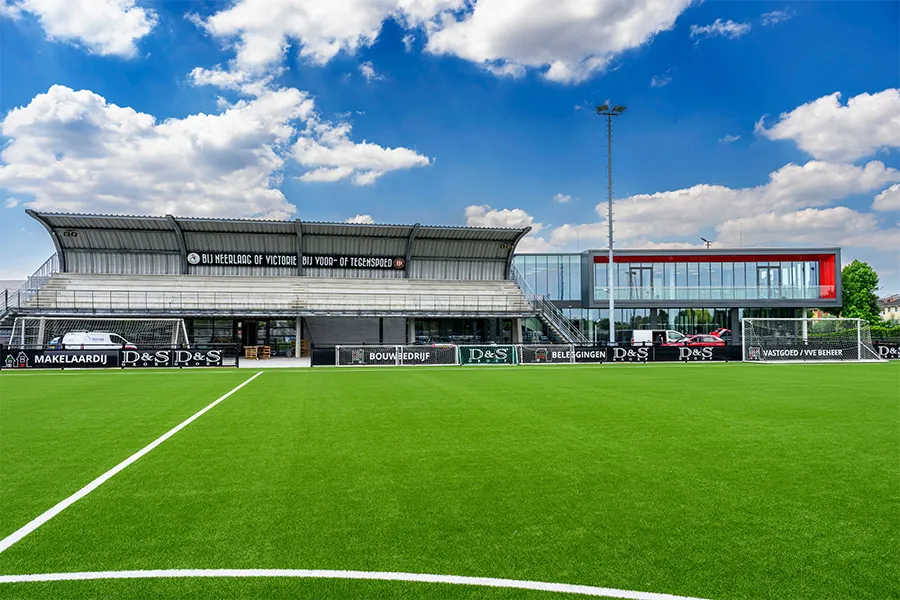
Sparta Rotterdam’s refurbished training complex in Nieuw Terbregge has been ready for use since this summer. The first-team squad and Jong Sparta now train on the pitches and in the new indoor training facilities. Coaches and support staff can hold meetings, analyse video footage and discuss tactics there. And all in a highly comfortable and energy-efficient environment, made possible in part by the Mitsubishi Electric VRF system, designed by SPIE and installed by Mur Conditioning.
A major refurbishment and expansion of the existing sports complex, where Sparta’s first team and youth teams had already been training, began more than a year and a half ago. The facilities on site were inadequate at the time. There was a need for a building with facilities where players and staff could work towards top-level performance and relax after training. The sports complex buildings clearly needed upgrading. A substantial refurbishment followed, with the old building making way for new facilities including a players’ lounge, sports hall, changing rooms, stand, canteen, and office and meeting rooms. Since summer 2024, all Sparta teams have been able to use the new complex.
Greater comfort and energy efficiency
The contract for the construction and building services went to two companies: Bezemer Bouw and SPIE, both long-standing supporters and sponsors of Sparta Rotterdam. Bart van Verseveld is a project manager at SPIE and, together with his colleagues, is responsible for the building services concept. “The original design specified a heating and cooling system with two large heat pumps, each rated at 140 kW,” he says. “We would then install a four-pipe distribution system on the ground and first floors, with underfloor heating and cooling downstairs and fan coil units upstairs. With comfort and energy savings in mind, we revised this concept and switched to two small heat pumps for the underfloor heating and cooling downstairs, and a VRF system for the first floor. This gives users greater comfort and is expected to significantly reduce energy consumption.”
Exchanging energy flows
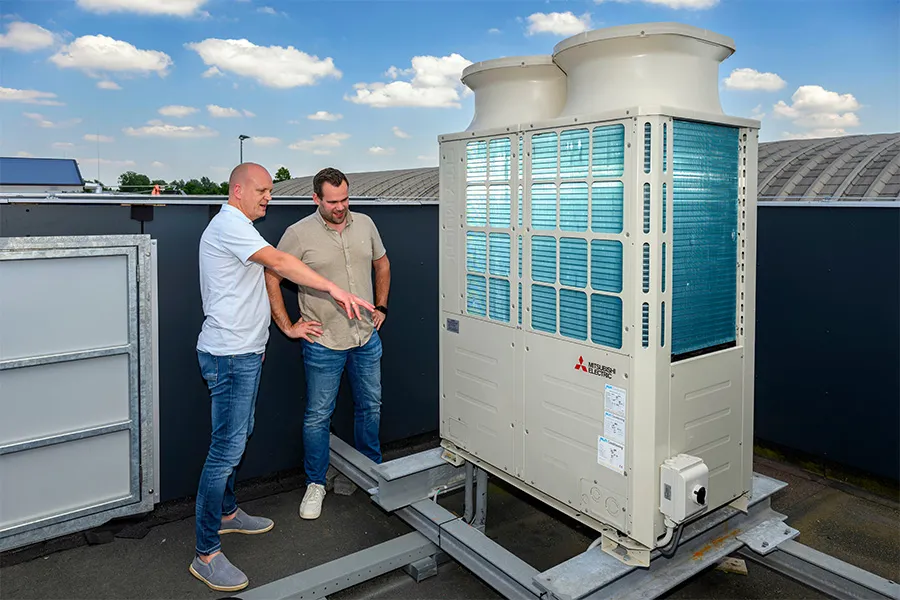
The various outdoor units are installed on the roof. These include the two 22 kW heat pumps that supply the distribution system on the ground floor, as well as the Mitsubishi Electric VRF system. This 40 kW heat pump provides a comfortable indoor climate in the first-floor rooms. There is also an air handling unit with an integrated heat pump for ventilation. “A key advantage of the VRF system is that it can heat and cool simultaneously,” says Van Verseveld. “It also exchanges heat efficiently. This helps make the system a good fit for the building’s energy-efficient design.”
Martijn van Leerdam, adviser at Alklima, the exclusive Mitsubishi Electric importer, adds: “Mur Conditioning installed two BC controllers in this building. These components are at the heart of the VRF installation, where heat and cooling are exchanged. Particularly in spring, users on the sunny side of the building may want cooling, while those on the shaded side want heating. In this case, the BC controllers use heat extracted from the south side to heat the rooms on the north side. This means the VRF system has to work much less hard and therefore uses less energy.”
A mix of cassette and ducted units
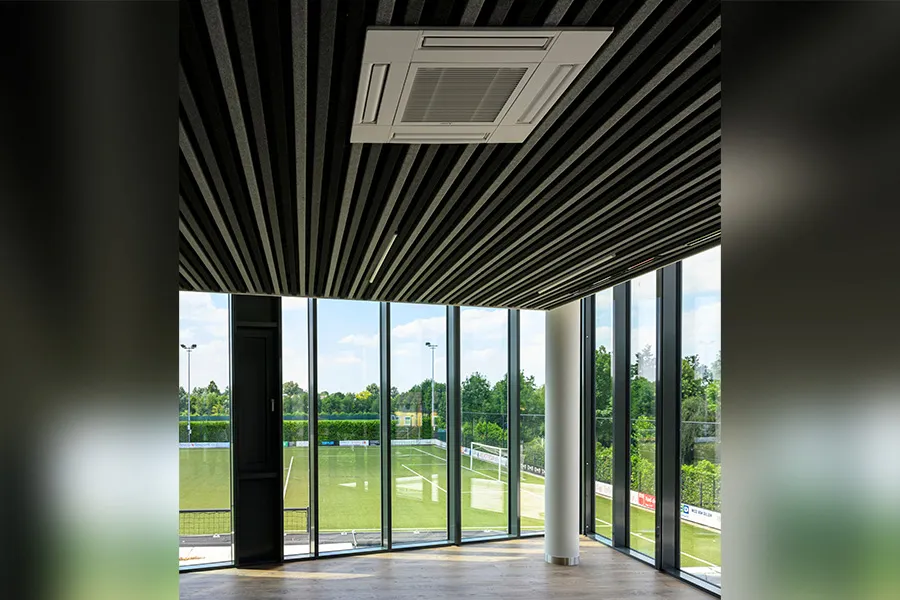
Mur Conditioning installed a total of 18 cassette and ducted units in the first-floor rooms. “We carefully integrated the cassette units into the ceilings,” says director Dylan Ravestein. “We know Mitsubishi Electric systems inside out. We install these units almost every week. The location was the main highlight here; it’s great to have been involved in such a special sports complex.” As well as ceiling-mounted cassette units, Mur Conditioning installed ducted units in other areas. In some cases, a fabric air-distribution duct was connected to the ducted unit to improve temperature distribution.
Pressure test and inspection
“Once we had completed our installation work, we carried out the pressure test required for this category 2 installation,” says Ravestein. “An inspection was also carried out, after which we could sign off the installation and hand the logbook to the client. This ensures that all requirements have been met and the customer can enjoy optimum comfort.”
Various external factors meant that the refurbishment and new-build work took longer than planned. “But that did give us time to develop the best possible building services concept,” concludes Van Verseveld. “With Mitsubishi Electric’s City Multi VRF system and all the matching indoor units, we offer the perfect solution for the climate on the first floor. The choice of this system was genuinely based on the best price-performance ratio, a decision that will bring the client considerable benefits.”
Question about this story? Ask your question
Keep following this
Get an email when a new story is published. No account needed.
- SubjectGeneral







