Energy-efficient ventilation with variable air volume dampers
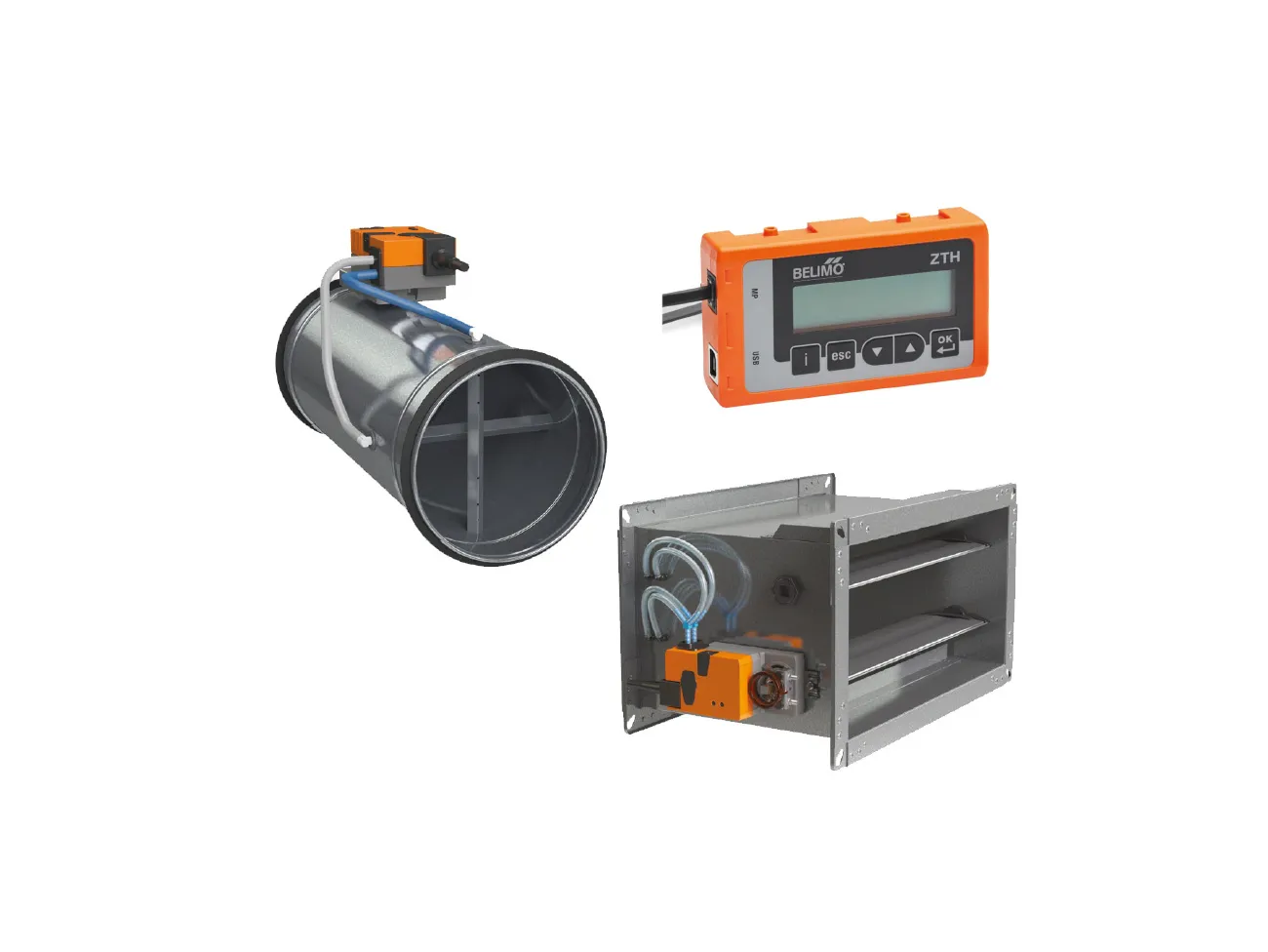
Choose the right damper, measuring cross and actuator
In the current crisis, we must avoid all unnecessary energy use. This applies not only to lighting and heating, but certainly also to ventilating buildings and homes. Variable air volume dampers can play an important role in this.
In buildings such as offices, schools, multi-purpose centres, healthcare facilities and government institutions, demand-controlled ventilation saves money. All too often, an air handling unit or fan runs continuously at a fixed setting, without taking account of the people present. New systems are often fitted with sensors to adjust the airflow rate, as is the case in schools, where CO2 sensors will soon be mandatory. In some cases, this is a step forward.
Hidden pitfalls
But there is another solution: variable air volume dampers. These dampers are installed in each room, preferably in both the supply and extract air ducts. The VAV damper uses a blade, a measuring cross and an actuator to regulate the airflow between a set Vmin and Vmax. The quality and design of the measuring cross are particularly important for accurate measurement at low air velocities. As well as a well-functioning VAV damper, the choice of sensor matters. A sensor operating on the basis of CO2, relative humidity or temperature increases the airflow as the load rises. This works well in principle, but there are some pitfalls. For example, with a CO2 sensor, the VAV damper will provide little ventilation when the load is low, but also when the temperature in the room rises sharply. If the ventilation or air handling system also controls cooling or heating, this presents a challenge.
It is also possible to control the sensor based on temperature, with the highest value taking precedence. However, this only works in one direction: more air at a higher temperature, and too little air when the temperature is too low. Another pitfall is the CO2 sensor setting (1 to 2,000 ppm). At a threshold of 1,000 ppm, the VAV damper will remain at 50% capacity, raising the question of whether this is sufficient. The damper only opens fully once the level reaches 2,000 ppm. This undesirable situation can be avoided by using a sensor with an integrated PI controller. When VAV dampers are used, the air handling unit or ventilation unit must have constant pressure control. The VAV dampers can also be used as CAV dampers.
Komfovent supplies VAV/CAV dampers fitted with a specially designed measuring cross, suitable for low air velocities. For direct connection to, for example, a building management system, communication options include analogue, MP-Bus, Modbus, BACnet and KNX.
Question about this story? Ask your question
Keep following this
Get an email when a new story is published. No account needed.
- ThemeHealthy indoor air
- SubjectYearbook