Plug-and-play power module for construction, infrastructure and the (solar) industry
With the 2050 climate targets in sight, more and more construction, installation and infrastructure companies are switching from fuel-powered to hybrid or zero-emission equipment and machinery. Not only because this is their own ambition, but also because municipalities, provinces and other clients are asking them to do so. “Projects are increasingly being awarded on the basis of the Most Economically Advantageous Tender, where sustainability carries as much weight as price,” says Ronald van den Berg, Construction, Installation and Infrastructure Sector Specialist at Top Systems. “We are responding to this, for example, with the PowerBlock: a power module that can be installed plug-and-play in any site cabin and then operate as a standalone 3-phase power module (3×5 to 3×15 kVA) or as a hybrid system.”
On the way to a sustainable, carbon-neutral future
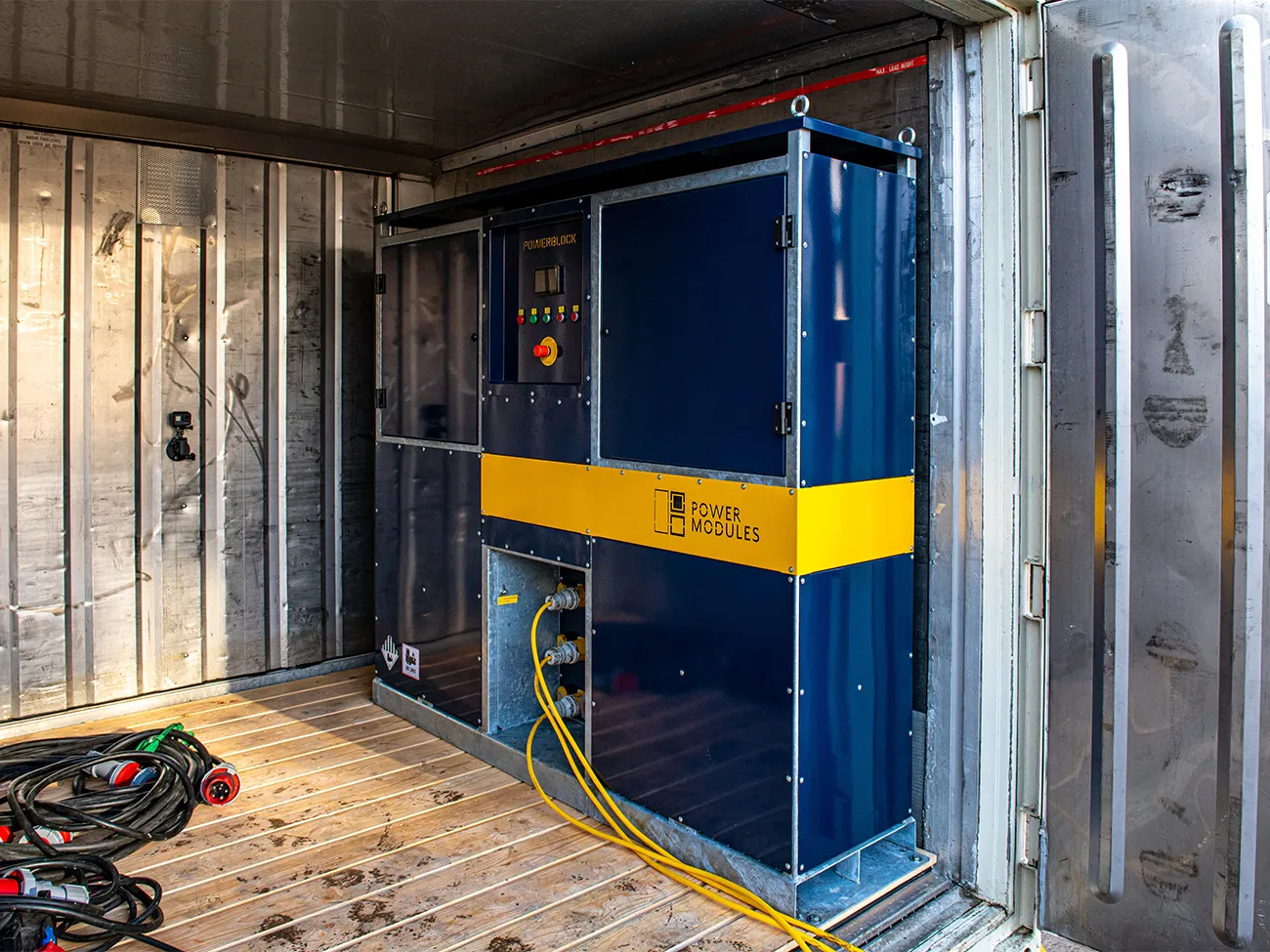
The PowerBlock can reduce generator running time by up to 90%, resulting in 90% lower emissions of nitrogen, CO2, sulphur, soot particles and other fine particulates from exhaust gases. Noise pollution for the surrounding area is kept to a minimum, while fuel costs and maintenance can be significantly reduced. The generator’s service life is also considerably extended.
The power module’s core components
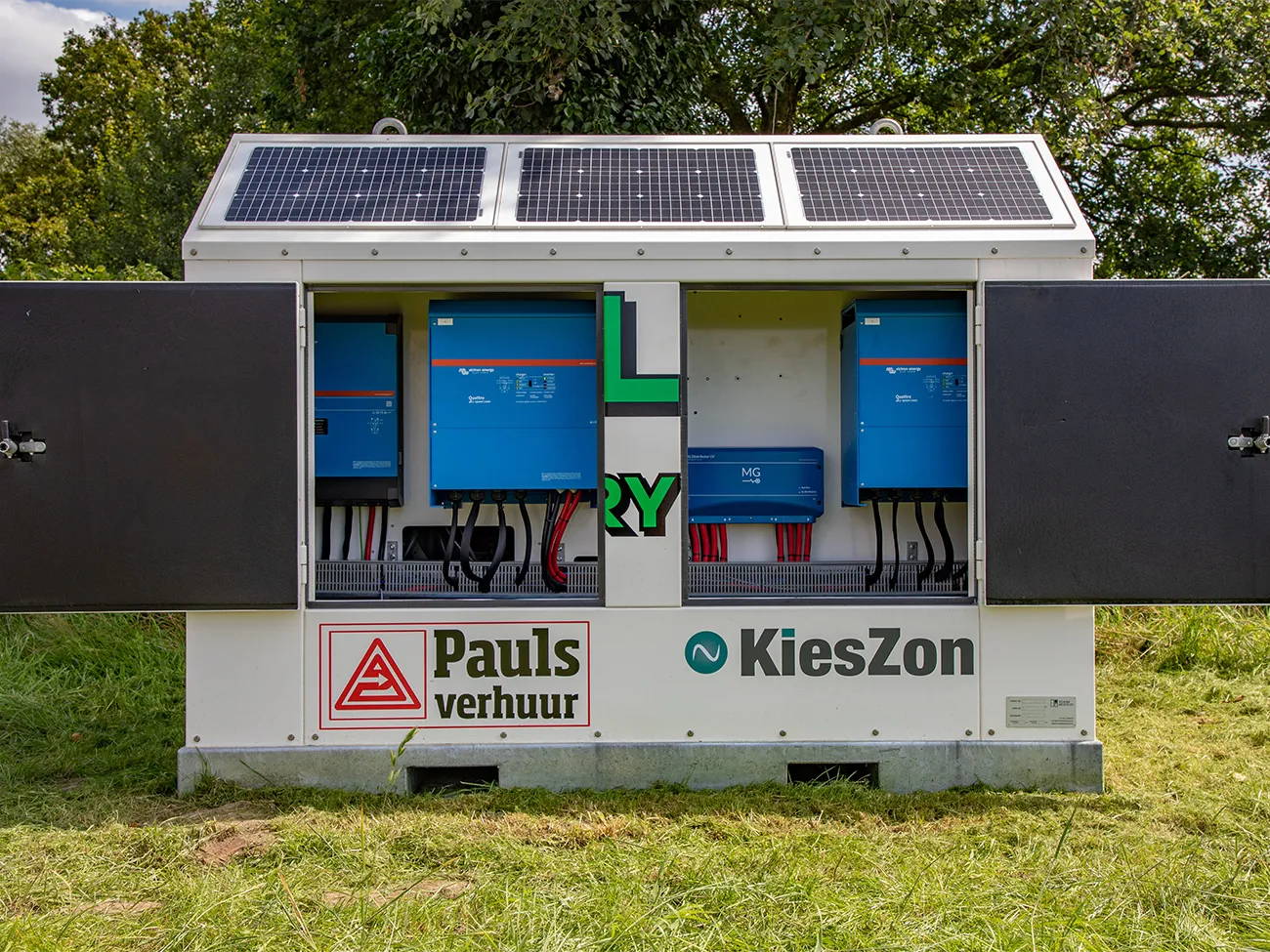
The PowerBlock is available in various configurations. “At its core are three Victron Quattro inverter/charger combinations, rated from 5 to 15 kVA, with two AC inputs (generator and mains) and an MG Energy Systems battery pack with a capacity of 14.4 to 86.4 kWh,” says Van den Berg. “The battery system is protected and monitored 24/7 by an MG Master Battery Management Controller, which prevents overcharging, excessive discharge and excessively high or low temperatures. The Battery Management Controller also ensures that the batteries are properly balanced and tracks key parameters such as battery status and energy consumption. A Victron Cerbo GX communication module handles control and monitoring, while a Victron Cerbo GX Touch 50 touchscreen control panel gives the operator real-time access to all readings. The PowerBlock has its own internet connection, making it easy to read and monitor the readings remotely via the Victron Remote Management portal. An integrated heater also prevents the lithium-ion batteries from getting too cold.”
Solar panels can be installed on top of the site cabin to charge the batteries during the day. A Victron SmartSolar MPPT solar charge controller in the PowerBlock converts the solar energy generated into charging current for the batteries. The PowerBlock can also be used as an emergency power system and for peak shaving.
Reliable, robust and safe
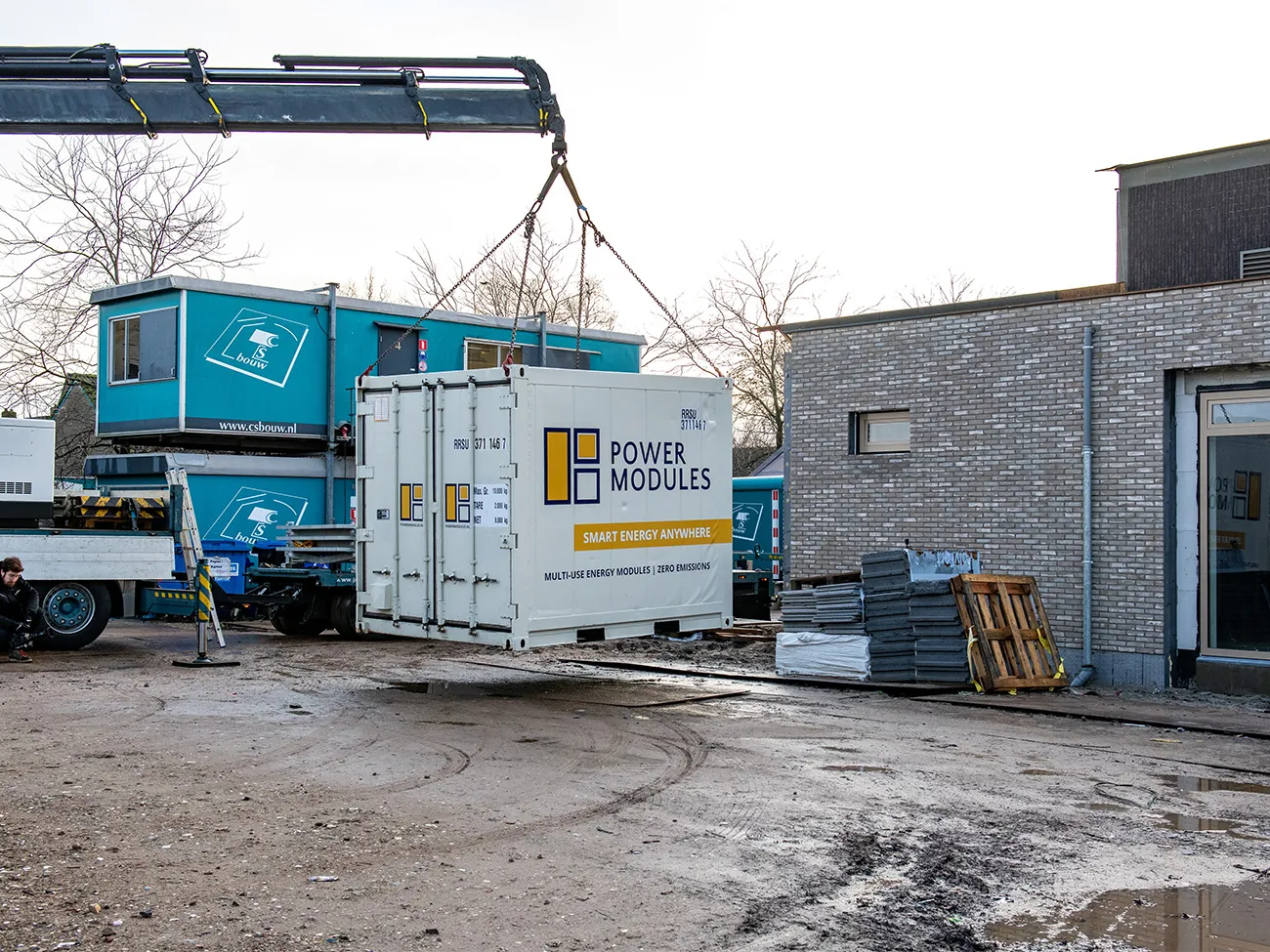
Power Modules B.V. is responsible for the engineering and construction of the PowerBlock power modules. The company develops temporary, plug-and-play power systems combined with a battery pack for locations without an electricity supply. Reliability, robustness and safe operation are paramount. “Thanks to their compact dimensions, the PowerBlocks can be easily fitted into both large and small site cabins,” says technical developer Thomas Bode. “The modules can be picked up by forklift from all four sides and/or lifted into position using lifting eyes. The input and output plugs can only be connected one way, preventing connection errors. The installation can be switched on immediately after connection, and the PowerBlock is then operational. Another major advantage is that the module has only one operating side.”
A solution for the solar industry
The PowerBlock power modules were initially developed for installation in site cabins and are therefore not waterproof. This is not a problem for construction, installation and infrastructure projects. But some sectors, such as the solar industry, require outdoor installation. KiesZon is a well-known player in this market and has been delivering commercial and industrial solar power projects since 2009. “KiesZon is committed to making the Netherlands more sustainable. We are helping to shape the solar revolution,” says Operations Manager Joost de Vogel. “With this in mind, it seems odd that we still have to use hybrid or diesel generators to make buildings more sustainable and/or install solar farms. For example, to power our site and construction processes. We have developed an alternative in close collaboration with Pauls B.V.”
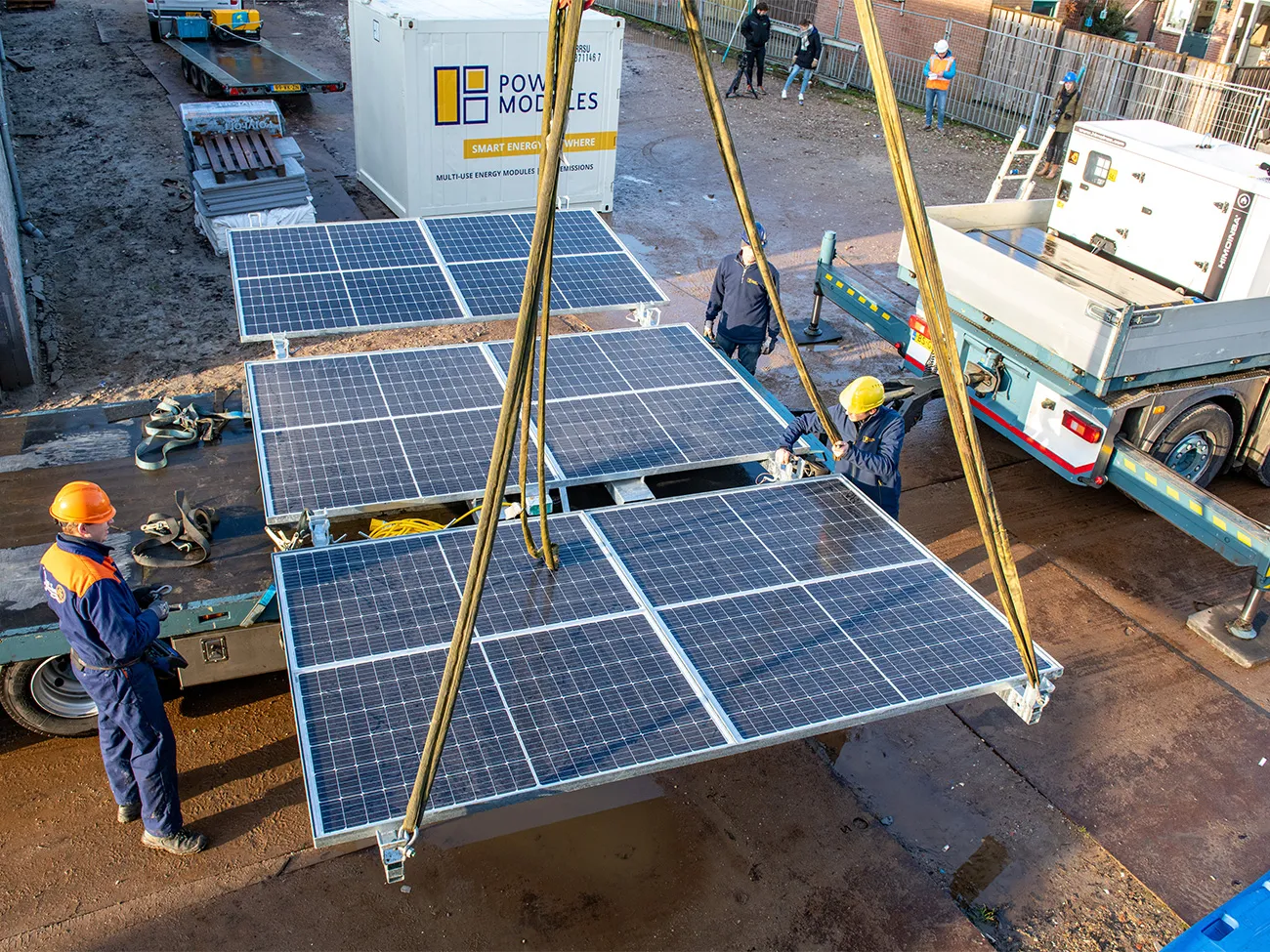
KiesZon uses, among other things, Pauls B.V.’s electric construction cranes, telehandlers and generators to deliver its projects. A customised PowerBlock, the SunBlock, has recently been added to the range. “Solar panels are sustainable, but in most cases, installing them is not yet,” says Paul Peters, owner of Pauls B.V. “When I heard that KiesZon wanted to connect solar panels to the hybrid generator, I suggested putting forward a proposal that went much further. My ambition was to develop a battery-based power system that could run 100% on solar energy. A system that could connect large numbers of solar panels, making a real difference. I contacted Top Systems to develop the concept.”
Specific requirements
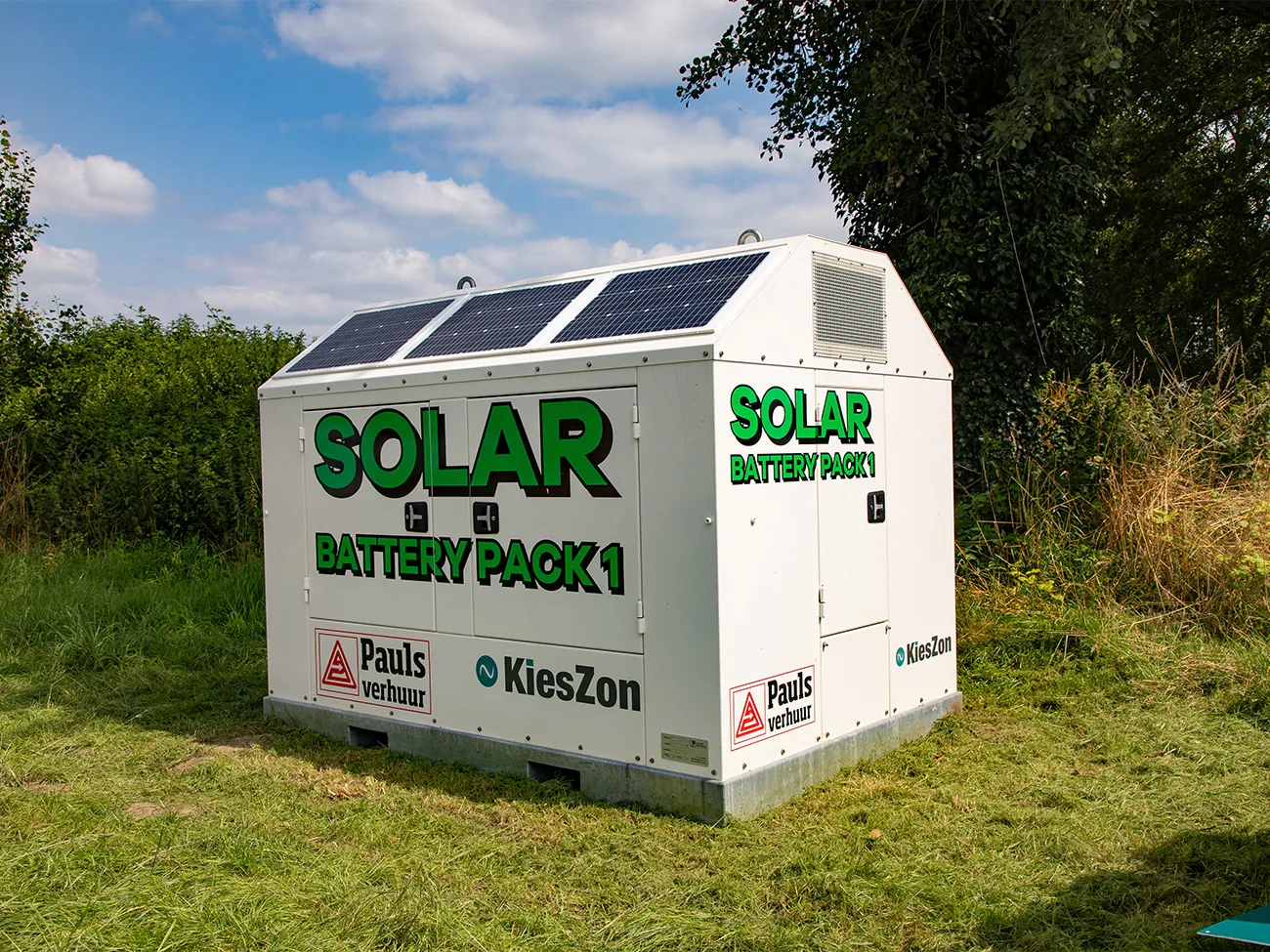
Pauls B.V. worked with KiesZon to define the technical specifications for the SunBlock power module, including its installed power and battery capacity. “The aim was to be able to work on 100% solar energy for around a day and a half,” says De Vogel. “The batteries need to supply enough energy for the site cabins, to operate the electric construction cranes and to charge hand tools. The charging point is a useful addition, allowing our site teams to charge their cars at work using 100% self-generated electricity.” Peters also wanted a durable, well-protected system that tenants and technicians could use without problems. “The enclosure also had to look attractive and inviting,” he says. “Generator enclosures are often square, but we chose a house-shaped design, with the solar panels clearly visible on the roof. This sparks the curiosity of passers-by and gives a boost to the sustainable image of the company delivering the solar project.”
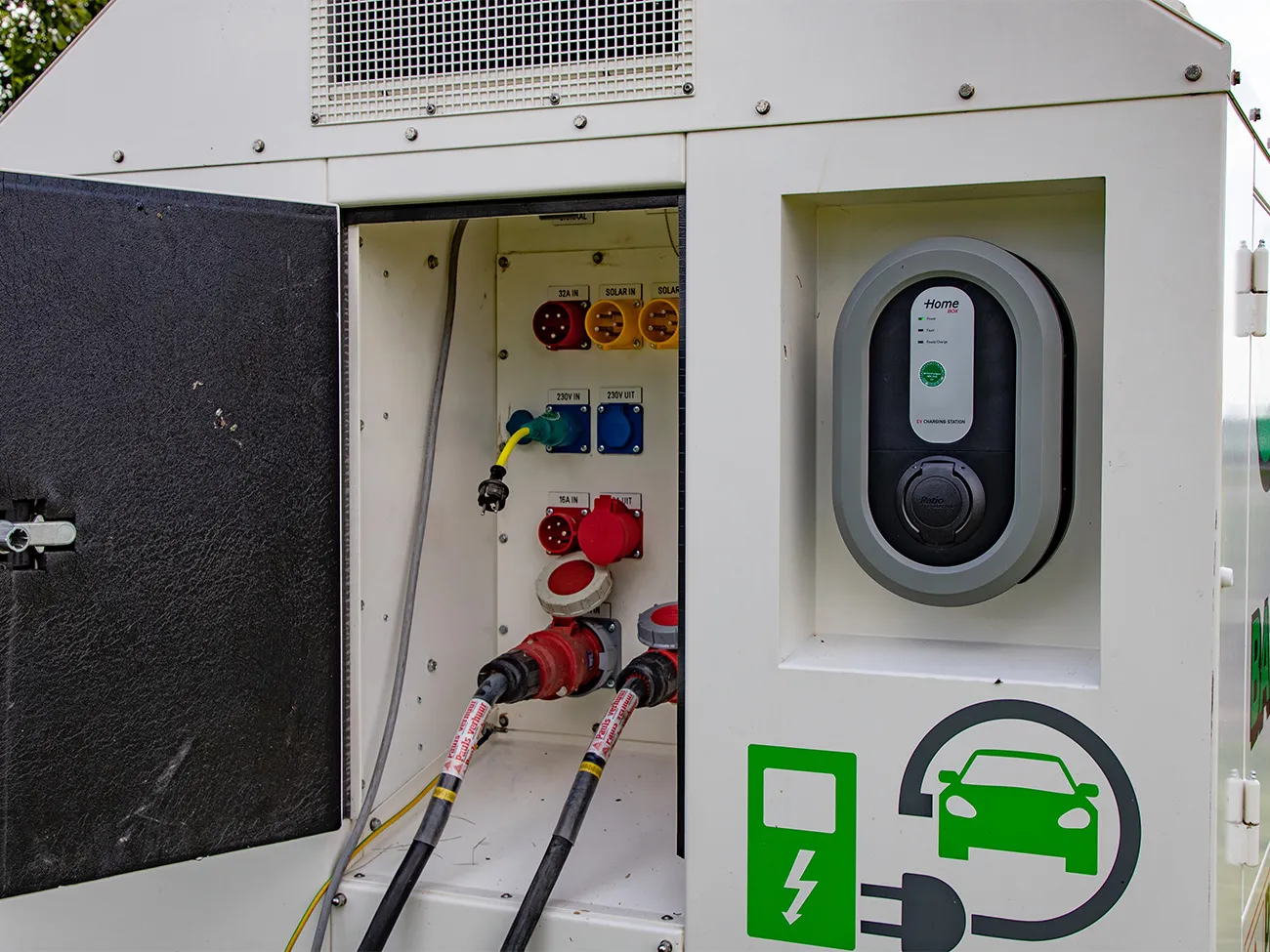
The SunBlock power module was redesigned from the outset in close collaboration with Top Systems, Bode stresses. “The biggest change is the enclosure. We opted for a powder-coated steel enclosure with a galvanised base tray to prevent corrosion and rust. We also added comprehensive climate control. In addition to the heater, a fan with an extensive ventilation control system has been installed to provide the required cooling on demand. This also prevents condensation inside the enclosure. Louvre vents keep out rain, while a special filter prevents contamination of the system components.”
Technical specifications
All system components are mounted along the long side of the power module, while the AC inputs and outputs are located at the end, Bode explains. “A lockable door has also been added here to prevent break-ins and vandalism. At the other end, a storage compartment has been created for cables and distribution boxes, with the solar panels connected using a standard MC4 plug. The distribution boxes divide the solar panel strings efficiently. This is an important feature because the MPPT solar charge controllers can handle a maximum voltage of 250 volts.”
The module is equipped with three Victron SmartSolar MPPT solar charge controllers rated at 100 amps, with the option to expand to five. Installed power is 50 kVA. “To provide this power, we developed a multi-system comprising a 45 kVA 3-phase module and a 5 kVA single-phase system. The battery pack contains eight batteries with a combined capacity of 57.6 kWh. The battery pack can be expanded to a maximum of twelve batteries (86.4 kWh), if required. Two additional solar charge controllers (11.6 kWp) can also be added.”
A great success
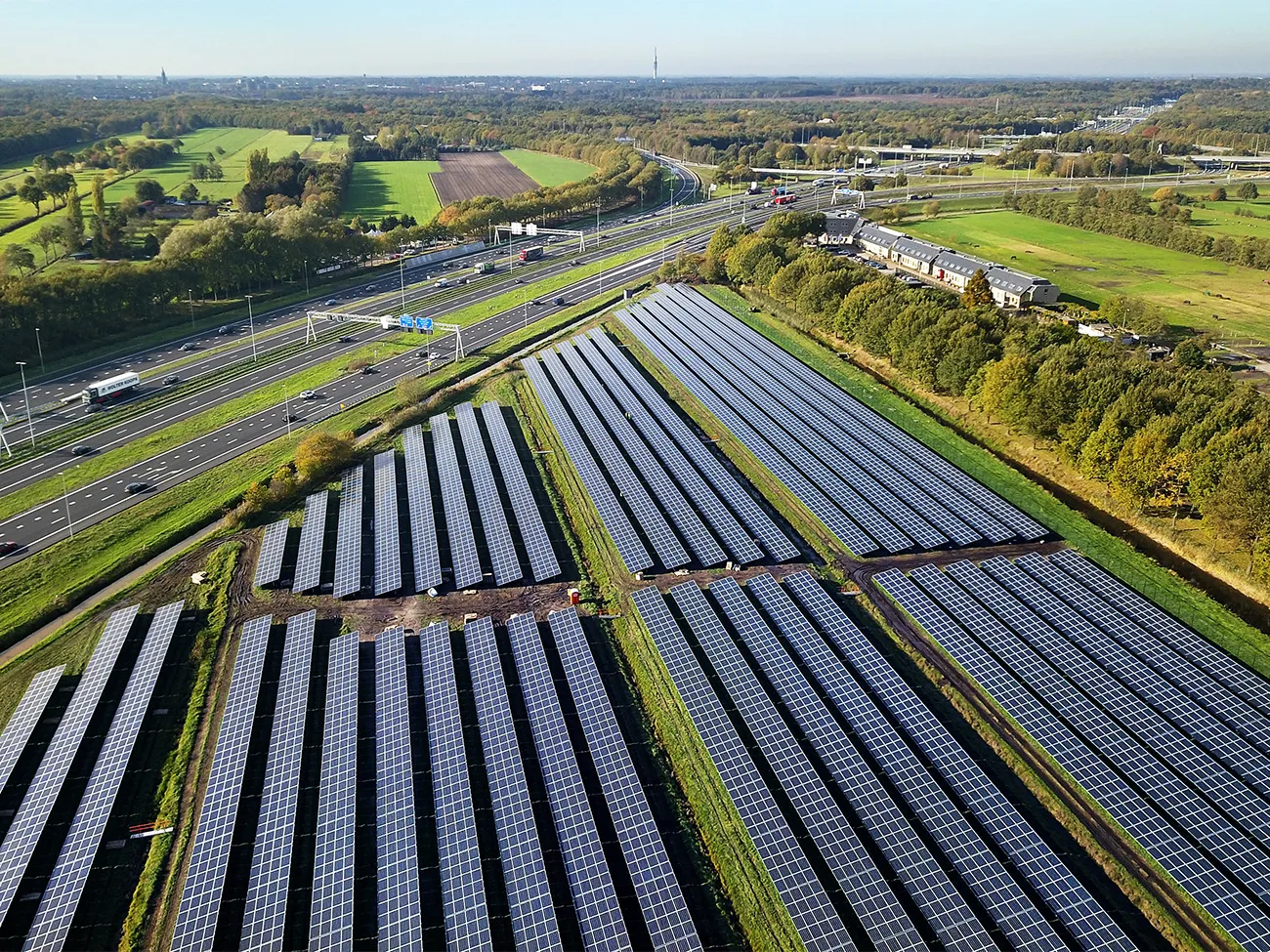
The SunBlock was commissioned in October 2020. Its first assignment was a field project in Puttershoek, with more than 66,000 panels. The power system is currently at Zonnepark Batendijk in the municipality of Berkelland, where around 17,000 solar panels are being installed. “For us, the SunBlock is a great success on the road to a sustainable, carbon-neutral future,” De Vogel stresses. “We have seen a huge reduction in diesel consumption on both projects.”
On projects without an electricity supply, KiesZon still combines the SunBlock with a generator, which charges the batteries for the first few weeks. “This immediately creates a hybrid system,” says Peters. “Instead of running continuously, the generator only starts up briefly when the batteries reach their critical threshold.” De Vogel adds: “At our ground-mounted installations, we lay a section of the solar farm as soon as possible or set up a test bench with panels, which we connect directly to the SunBlock. This steadily reduces generator use until it serves only as a backup.”
For rooftop systems, KiesZon also installs an initial section of roof as soon as possible, so that the grid connection can be replaced with 100% self-generated electricity. “When the sun is shining, the solar panels can generate up to 17 kW/h to charge the batteries,” says Van den Berg. “This means that around 70 kW of solar energy can be generated each day.”
Just the beginning…
KiesZon and Pauls B.V. are currently evaluating their first project. What further improvements are needed? Peters: “In the short term, a timer will be added so that heating, air conditioning and lighting in the site cabins are not left on unnecessarily overnight, allowing the solar energy generated to be used even more efficiently.” De Vogel: “In future, we would like to develop the SunBlock further into a system specifically for rooftop projects, where our energy consumption is somewhat lower. We also want to develop a higher-capacity system for larger projects in the winter months. In short, this SunBlock is just the beginning….”
Question about this story? Ask your question
Companies in this story
Keep following this
Get an email when a new story is published. No account needed.
- SubjectYearbook
- CompanyTop Systems B.V.
- CompanySolar