











School ventilation is essential for a healthy learning environment
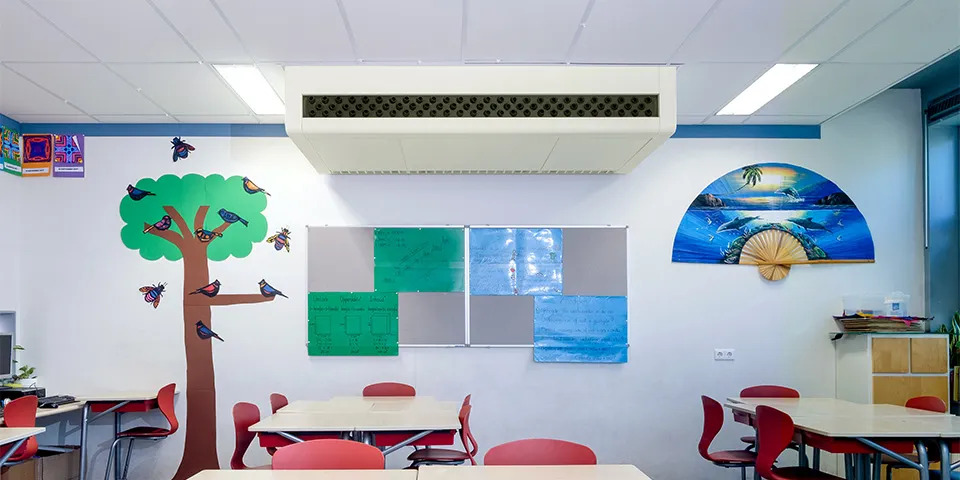
In September 2015, the Programme of Requirements (PvE) Frisse Scholen, issued by the Netherlands Enterprise Agency (RVO), was expanded to include heat recovery. That happens to be Ned Air’s core business. We speak to managing director Wouter Wijma about how schools call for a non-standard approach.
“Ned Air has now been active in the school ventilation market for four years,” Wijma begins. “We first got involved through the VLA when a market player raised the white flag on a project in Amsterdam. It turned out that a bespoke solution was needed.”
Expertise bears fruit
For the school in Amsterdam, Ned Air went back to the drawing board and developed a prototype intended to solve all the problems. Wijma: “It was a successful development. We were then able to produce 60 units of that prototype, which have successfully created a healthy indoor climate. We now produce more than 200 of these systems a year.”
Silence in the classroom!
You can almost hear the teacher saying it. But silence is important not only for pupils, but for ventilation too. The PvE Frisse Scholen 2015 divides schools into classes A, B and C, with the strictest noise requirements applying to class A ventilation. “The biggest difference between school ventilation and standard ventilation is the noise level. Under the class B requirements in the PvE Frisse Scholen, it must remain below 33 dB(A). This class applies to primary education, and our EduComfort systems meet the requirements. For secondary schools and universities, class A applies, with a limit of 30 dB(A). Our range includes the EduComfort 950 and the CM 1100 LN (low noise), which can operate above a suspended ceiling. In both cases, these are decentralised units,” says Wijma.
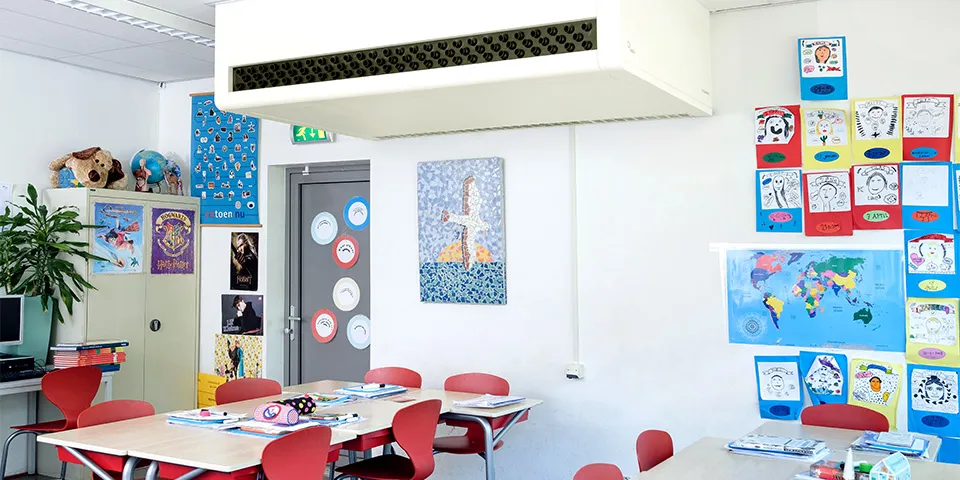
Ned Air EduComfort 950 delivers optimum performance in the classroom.
School buildings are therefore subject to different requirements from homes and commercial buildings. “We are clearly seeing a trend towards installing above the suspended ceiling and choosing all-air solutions that also include full heating. However, we recommend retaining one or two radiant heat sources, such as radiators, as pupils sitting close to the window would otherwise feel colder than those elsewhere in the classroom.”
Improved learning outcomes
Wijma is pleased that the issue is gaining traction, although there is still no consensus on requirements across Europe. “In the Netherlands, we work with 950 m3/h of air for class B. In France, for example, the figure is between 450 and 600 m3/h. In any case, the issue is gaining traction everywhere. Pupils’ performance in Frisse Scholen improves by an average of 20% to 25%. Absenteeism due to illness falls by an average of 20%. I still remember a school head’s response: she thanked me and said that teacher sickness absence had fallen dramatically since the system was installed.”
Business for good
Ned Air wants to look beyond the units it supplies. “We want every pupil to have a healthy school building. We have made this our mission, and the whole organisation is committed to it. We call it ‘Business for Good’, and it serves a purpose that goes far beyond simply making money. Profit is secondary; it comes naturally as a reward for good work.”
A business enquiry for Ned Air? Get in touch
Companies in this story

Keep following this
Get an email when a new story is published. No account needed.
- ThemeHealthy indoor air
- SubjectHVAC
- CompanyNed Air







