Dutch superyacht building is going big, bigger, biggest
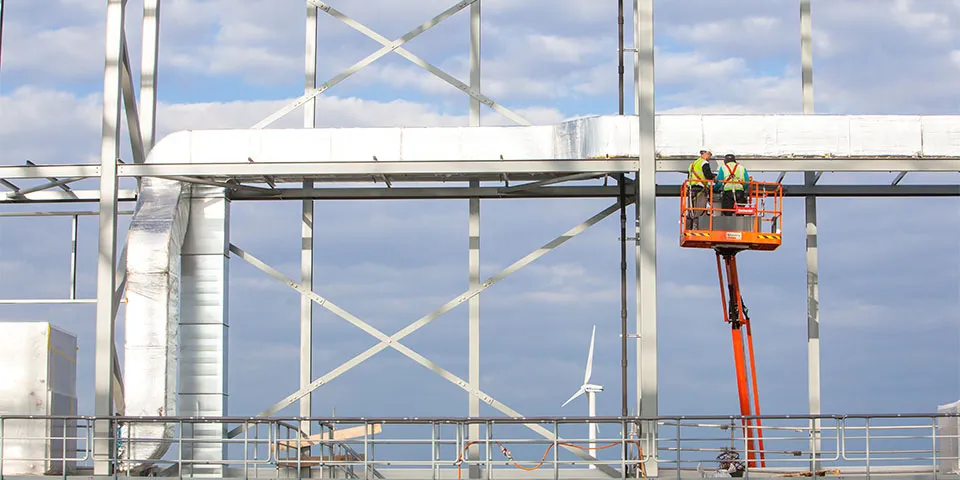
The superyacht sector, covering yachts of 30 metres and over, is thriving. The Netherlands, too, is playing an increasingly important role in the global superyacht industry. Several shipyards are currently scaling up to meet growing demand for large yachts, up to 160 metres. They are not building standard shipyards, but state-of-the-art halls that stand out for their construction technology, sustainability and appearance. “Superyacht building is a world inhabited mainly by the super-rich, and it calls for a specific approach,” says Marc Oudt of Vink Systemen. “Yachts are invariably built and displayed in a showroom-like environment that must be finished down to the smallest detail. That includes the air ducts.”
From Royal van Lent Shipyard’s new shipyard in Amsterdam and Oceanco’s yacht halls 1 and 2 in Alblasserdam to the Feadship project by Koninklijke De Vries Scheepsbouw in Aalsmeer, Vink Systemen is involved in an increasing number of superyacht construction projects and can now count itself an experienced specialist. “We see a number of common features in superyacht building in the Netherlands,” Oudt explains. “An optimal working environment must be guaranteed at all times. Supplying fresh air precisely where it is needed and extracting stale air efficiently play an important role, as does the careful extraction of spray-paint fumes.” This sounds straightforward, but it is anything but. “The halls being built today are often up to 30 metres high. Climate-controlling these halls requires an average of 5,000 to 10,000 m² of ductwork, with ducts sometimes as large as 2 metres wide and 1 metre high. Installing these air ducts neatly at height requires not only thorough planning and coordination, but also carefully planned logistics.”
Working at height
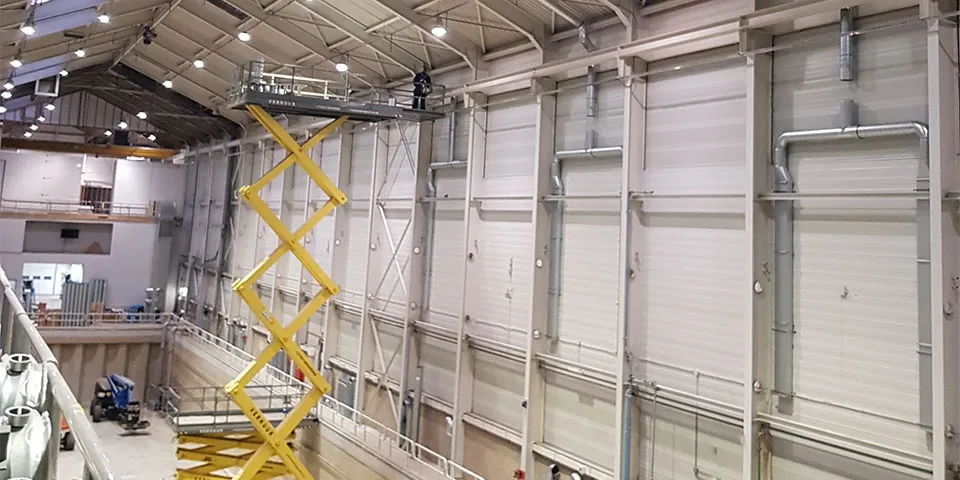
The Feadship project by Koninklijke De Vries Scheepsbouw in Aalsmeer.
Broadly speaking, Vink Systemen has three options. “First, we can attach the air ducts to the steel structure,” says Oudt. “In that case, we work our way up alongside the steelwork contractor and use the site crane. This is no easy task, as our installers have to secure the duct sections from a mobile elevating work platform at a height of 30 metres. It is not a job for every installer.” An alternative is to attach a separate steel structure to the rafters of the main supporting structure, with the air ducts placed on top. “This approach is also labour-intensive, because it requires scaffolding 30 metres high, equipped with large lifts to raise the duct sections,” Oudt says. “A middle-ground option is to have the steelwork contractor install all the support steel for the air ducts, after which we use large telehandlers to position the ductwork in the structure.”
A showcase for the yacht builder
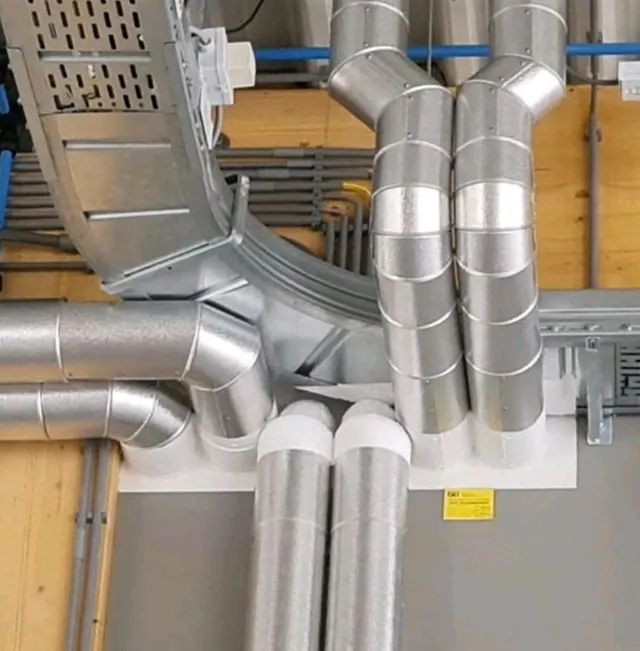
Oudt says that the superyacht halls being built today are often a showcase for the yacht builder. “The halls have to be in perfect condition. This means that all the air ducts must be perfectly aligned and the supports fixed at equal intervals. Dents, scratches and leftover stickers are out of the question, because all the ductwork remains visible. Any imperfection immediately catches the eye. Careful installation is therefore essential, and it is something we are happy to provide.”
Question about this story? Ask your question
Keep following this
Get an email when a new story is published. No account needed.
- SubjectProjects