Indirect adiabatic cooling for Datacenter Leipzig: ‘Safe and energy-efficient data storage’
Storing and processing data generates enormous amounts of heat. It is no coincidence that, alongside power supply, cooling the racks is the biggest energy consumer in data centres. “Investing in sustainable cooling therefore pays off immediately,” says Maarten van Dalen, Regional Sales Manager Datacenter at FläktGroup. “With a cooling PUE of <1.1, we are at the forefront of energy-saving cooling systems. Advanced technology based on indirect adiabatic cooling is central to this.”
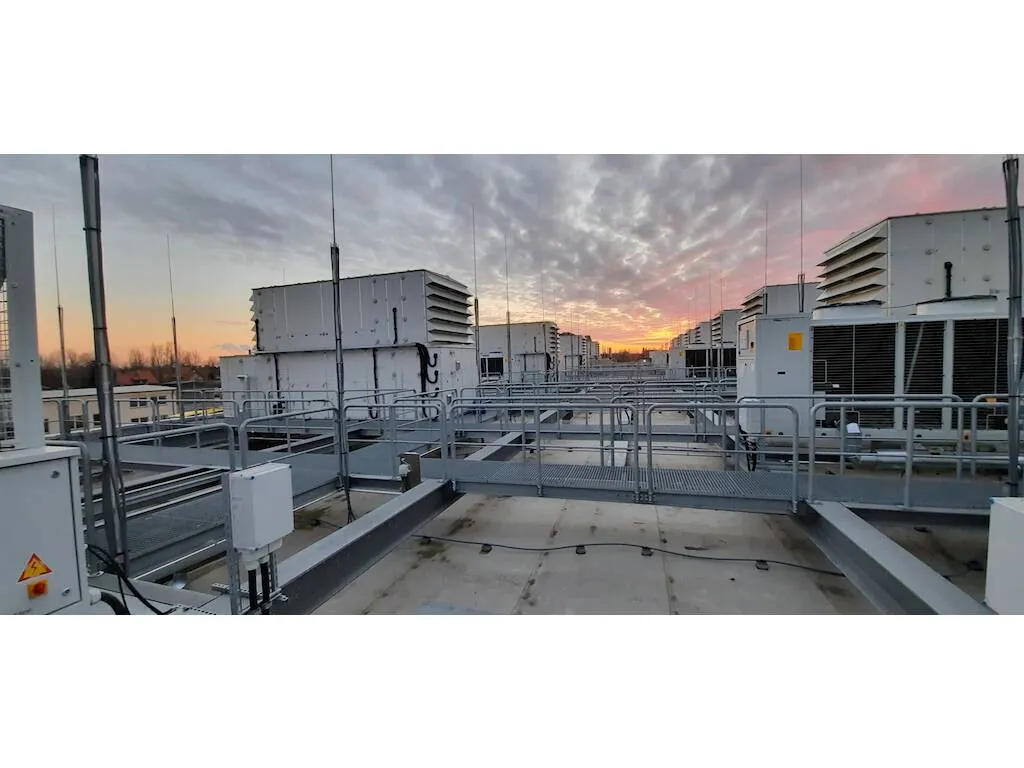
FläktGroup’s adiabatic cooling technology has recently been installed at the new Datacenter Leipzig, where the servers are used by, among others, the City of Leipzig and telephone provider HLKOMM. Cloud-based server rooms have also been set up for data storage and processing. “Four halls have been fitted out in total, each with installed server capacity of 700 kW (2,800 kW in total),” says Van Dalen. “FläktGroup’s challenge was to cool these halls as reliably and efficiently as possible.”
Constant temperature
To ensure the service life and availability of all the equipment in the data centre, while minimising energy use, it is important to keep the temperature in the ‘cold aisle’ constant at 24°C, Van Dalen emphasises. “Our systems can maintain this temperature at outdoor temperatures of up to 40°C. Our units continuously supply air at 24°C to the cold aisle, where it is drawn into the servers. The air then leaves the servers at 35°C in the so-called ‘hot aisle’. FläktGroup has designed an indirect adiabatic cooling system to cool this air back down.”
Ideal indoor climate conditions
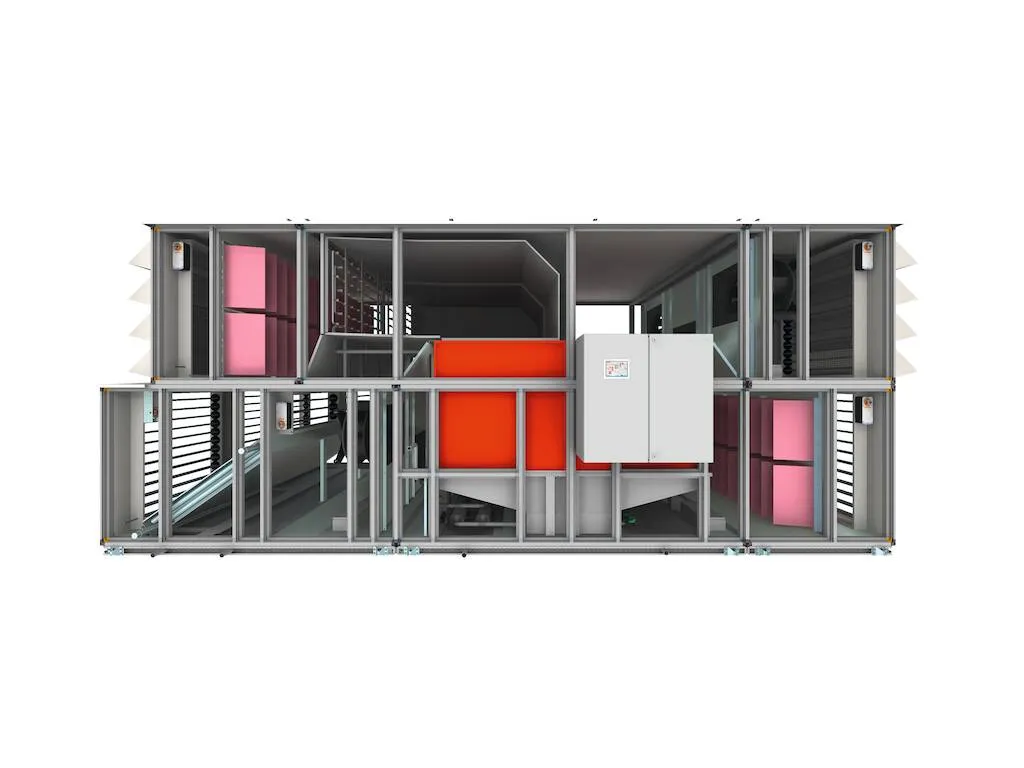
Adiabatic cooling is the most efficient form of cooling, because no mechanical input is required for basic cooling, Van Dalen emphasises. “The technology is based on cooling air through evaporation. The energy required for evaporation is efficiently drawn from the air, causing it to cool. The outdoor and indoor air sides of our Adia-DENCO units are fully separated by a plate heat exchanger. Waste heat from the data centre is exchanged with outdoor air, which is cooled adiabatically via a double cross-flow heat exchanger. This ensures a constant indoor climate and prevents contaminated outdoor air from entering the data centre. It is the ideal solution for a reliable, energy-efficient project.”
Quality and availability
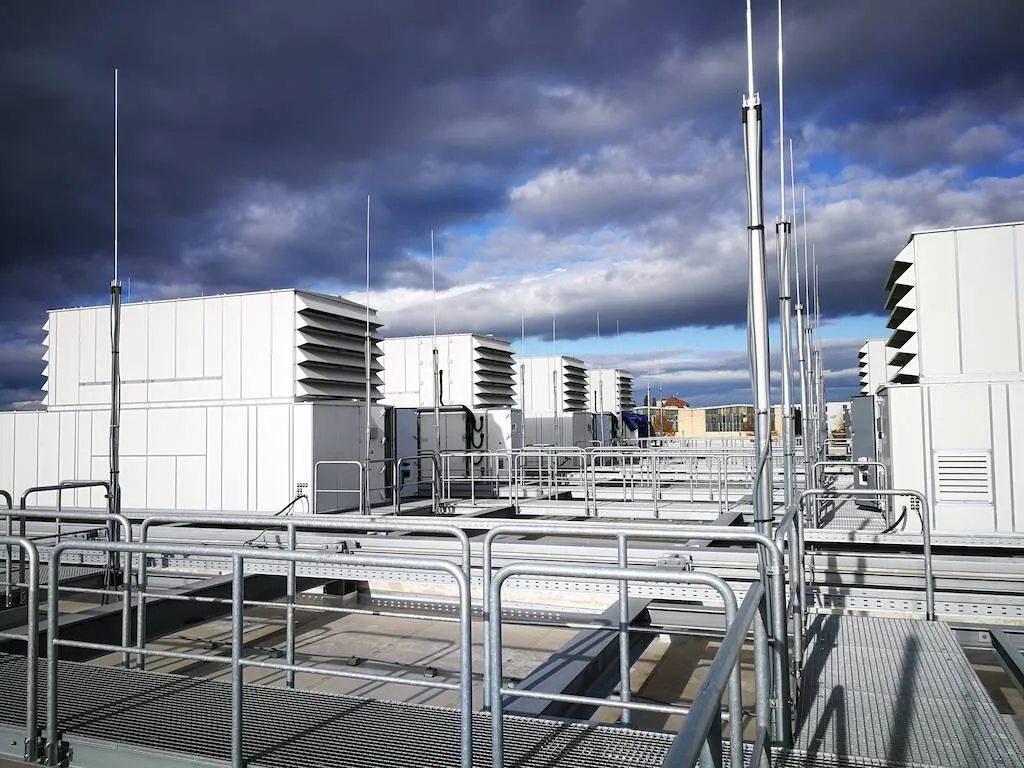
Commissioned by Penta-Infra, FläktGroup designed, supplied and installed 12 Adia-DENCO indirect adiabatic units, with Total Cost of Ownership as the guiding principle. “Each unit has a capacity of 234 kW, and an N+1 configuration was chosen,” says Van Dalen. “Four units have been installed in each data hall. This redundant configuration ensures optimum indoor conditions even if one unit fails.” If a unit should unexpectedly fail, the others can take over its cooling duties, he explains. “This means quality and availability are never compromised.” Before delivery, a successful Factory Acceptance Test was carried out at the FläktGroup factory, with all parties involved in attendance. Extreme conditions and unit failures, among other scenarios, were simulated during the test. Performance and reliability are hugely important.
Minimal energy and water use
A Roadmap 2030 has been drawn up for the Climate Agreement, setting out our commitment to use energy and water more efficiently and reduce our use of fossil fuels, says Van Dalen. “Data centres play an essential role in this. Around 20,000 TWh of energy is used in our country, of which 2,000 TWh is used by ICT. Data centres account for around 200 TWh of that. Power Usage Effectiveness (PUE) was introduced to demonstrate the energy efficiency of data centres. PUE shows the ratio between a data centre’s total power consumption and the power consumption of its IT equipment.” The current average PUE is 1.6-2.0. “FläktGroup’s Adia-DENCO heat recovery units, however, guarantee a PUE of <1.1. For every 1,000 kW of installed capacity, only 100 KW is needed for cooling (10%). This guarantees substantial savings, which are essential to meeting the 2030 climate targets.” Water conservation was also taken into account in the development of Adia-DENCO. “Adia-DENCO uses a reverse osmosis system. The membrane is designed to let small molecules of pure water pass through, while blocking larger particles or molecules with a chemical composition. Minerals and other dissolved substances that could damage the unit and/or the process are efficiently filtered out of the water. The result is clean water that can be reused sustainably. Combined with our intelligent software, this means there is virtually no risk of legionella and/or limescale build-up. This is an excellent example of sustainability and reliability working hand in hand.”
Question about this story? Ask your question
Keep following this
Get an email when a new story is published. No account needed.
- SubjectProjects