Schneider Electric joins forces with Hogeschool Utrecht to create the home of the future
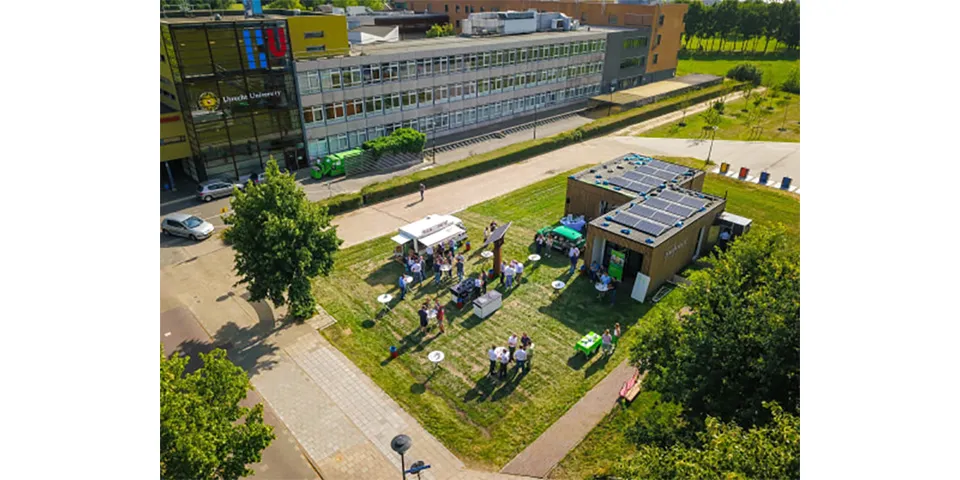
Students from Hogeschool Utrecht designed the home of the future in collaboration with various companies. Students from several disciplines took part in the project and contacted businesses themselves. They invited Schneider Electric, a supplier of comprehensive energy management and automation solutions, to advise on the technical aspects of the home. The impressive result of this collaboration is a fully self-sufficient, modular and circular home.
Sustainable measures
The government is currently taking many measures to help people in the Netherlands live in an increasingly energy-efficient and sustainable way. The Climate Agreement, the energy transition and the circular economy mean that we need to think about the homes of the future.
The home of the future
Schneider Electric, a specialist in energy management and automation, places great importance on sustainability and efficiency. “Energy demand is expected to double by 2040, and our current energy sources cannot meet this huge demand. That is why we are keen to contribute to initiatives of this kind for a more sustainable future. It is fantastic to work with young talent to improve the world and find this solution,” says Debby Slofstra, VP Building Schneider Electric. Safety and comfort are very important in the home of the future. Easy central control of the technology and its settings make for an exceptionally comfortable and safe home. For example, the user can set the blinds to lower automatically at sunset, so that residents are not bothered by the low sun, or have the system send an alert when doors are left open.
The future of learning
Just a few years ago, combining circular, modular and self-sufficient living in a new-build home seemed unthinkable. Hogeschool Utrecht has now made it a reality, thanks to the enthusiastic student team Selficient. The team shipped the home to Denver, America, to take part in the Solar Decathlon 2017, a competition for students organised by the U.S. Department of Energy, focused on developing and building new sustainable housing concepts. The home went on to win international awards, including the People’s Choice Award.
For Hogeschool Utrecht, students building a home of the future is also a way of learning for the future. “Challenge-based learning helps students develop entrepreneurial skills and ambition, and consider different perspectives. This gives them a huge advantage in the labour market,” says Arjen Bout, lecturer at Hogeschool Utrecht. For example, while still a student, Harold van Faassen, now System & Architecture Designer at Schneider Electric, found his current job at Schneider Electric through this project.
The future as a Living Lab
The home was not simply brought back to the Netherlands after the Solar Decathlon 2017. In the future, it will serve as a living lab for sustainable living. Students, researchers and business partners can work together to test new innovative systems and components in a real-life setting. The data generated by the home can be used to make the next home even more futuristic and sustainable.
Technical specifications
The home features the following Schneider Electric technologies and hardware:
The Smart panel makes it possible to control everything remotely. The PowerTags collect data from the panel to provide insight into energy consumption. Insight is the first step towards savings and greater sustainability.
• Powertag • the smallest wireless energy meter
• Installation circuit breakers • energy distribution
• Prisma G • the enclosure
Patch panel (Actassi)
Patch panels are normally found in data centres. As more and more household devices connect to the internet, a patch panel has been installed in this home to provide all the devices with a fast internet connection.
KNX installation
KNX helps ensure that residents live comfortably and safely in the home. All the equipment in the home can be controlled via a screen. The lights can also be controlled using the Multi touch pro and Push button pro. Preset scenes, for example, can switch off all the lights in the home at the touch of a button beside the bed when the resident goes to bed. Sensors help keep the home safe (door contacts) and maintain a comfortable indoor climate (CO², humidity and temperature sensors).
• Wiser for KNX
• Various sensors, including a weather station, PIR detector, door contact, CO², humidity and temperature sensors.
• Various actuators for lighting, solar shading and heating.
• U-motion screen
• Multi touch pro & Push button pro
EV charging point
To extend the focus on sustainability, the home naturally also needs to offer the option of charging an electric vehicle.
Other technologies:
D-life wiring accessories
Hybrid solar inverter system Conext.
Cable support systems
Een zakelijke vraag aan Schneider? Get in touch
Wie aan Hogeschool Utrecht werkte
- Control system
 WebeasyMentioned in Utrecht University of Applied Sciences’ sustainability is rewarded!
- student teamSelficientIn this story
Keep following this
Get an email when a new story is published. No account needed.
- ProjectHogeschool Utrecht
- SubjectProjects
- CompanySelficient
- CompanySchneider
- CompanySolar