Charge anywhere, any time, without a worry
Text Lieke BousemaImage Top Systems
Efficient, emissions-free charging of small and medium-sized equipment on site
Sustainable, clean and emissions-free construction. With the 2050 climate targets in sight, more and more construction, installation and infrastructure companies are switching from fuel-powered to hybrid or 100% electric tools and equipment. Not only because this is their own ambition, but also because municipalities, provinces and other clients are calling for it. Top Systems supports these companies with a wide range of energy systems for construction sites. From standalone 3-phase PowerBlock energy modules and hybrid systems to PowerCube outdoor cabinets and mobile energy carts. The energy specialist from Bodegraven offers solutions for charging all your small and medium-sized equipment.
Almost all nitrogen emissions from construction are caused by the use of mobile construction equipment. Construction machinery and vehicles, of which there are an estimated 80,000 in the Netherlands, often run on diesel and emit particulate matter and greenhouse gases as well as nitrogen. To limit these emissions, the government has set an ambitious target: a 60% reduction in nitrogen emissions by 2030 compared with the 2018 baseline year. To support companies in this, the Clean and Emission-Free Construction Equipment Subsidy Scheme (SSEB) has been launched. Since 9 May, companies in the construction sector have been able to apply for subsidies to purchase new zero-emission construction machinery and vehicles. These range from electric loaders and excavators and pile-driving machines to concrete mixers and tipper trucks. Energy systems with a battery capacity of >50 kWh are also eligible for the subsidy scheme, says Ronald van den Berg, Construction & Infrastructure Sector Specialist at Top Systems. “For example, we are responding to this with the PowerBlock: an energy module that can be installed plug-and-play in any site container and used as a standalone 3-phase energy module (3×5 to 3×15 kVA), with a generator handling peak demand.”
90% lower emissions
“The PowerBlock energy module can reduce generator running time by up to 90%,” says Van den Berg. “This results in 90% lower emissions of nitrogen, CO2, sulphur, soot particles and other particulate matter from exhaust gases. Noise nuisance for the surrounding area is also kept to a minimum, and maintenance costs can be significantly reduced. The generator’s service life is also extended considerably.”
Different versions
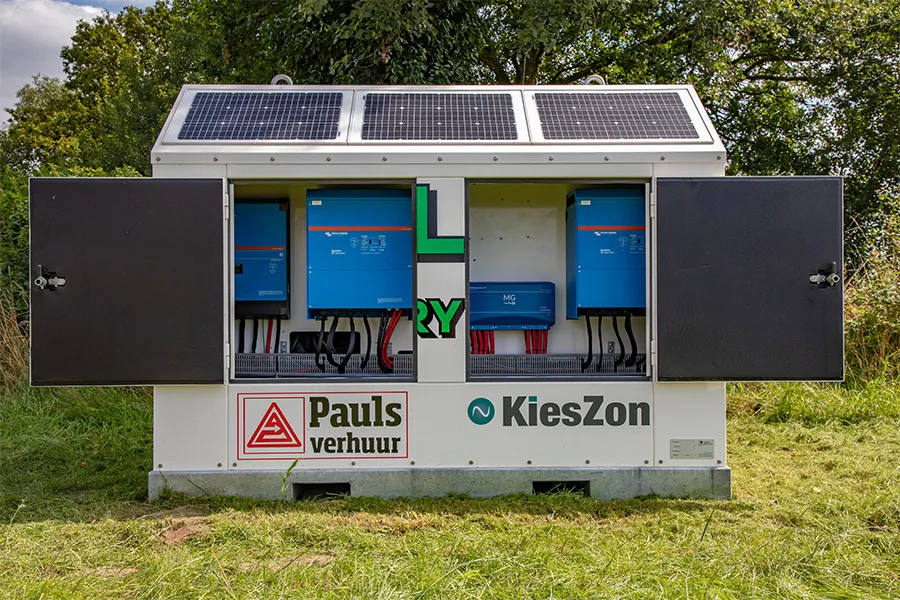
The PowerBlock is available in various versions. “At the heart of the energy module are three Victron Quattro inverter/charger combinations rated from 5 to 15 kVA, with two AC inputs (generator and mains power) and an MG Energy Systems battery pack with a capacity of 14.4 to 86.4 kWh,” says Van den Berg. “The battery system is protected and monitored 24/7 by an MG Master Battery Management Controller (BMC) to prevent overcharging, excessive discharge and excessively high or low temperatures. The BMC also ensures that the lithium-ion batteries are balanced correctly and tracks important parameters such as battery status and energy consumption. A Victron Cerbo GX communications module provides control and monitoring, while a Victron Cerbo GX Touch 50 touchscreen control panel gives the operator real-time visibility of all readings. The PowerBlock has its own internet connection, allowing readings to be viewed and monitored remotely via the Victron Remote Management portal. An integrated heating system brings the lithium-ion batteries up to temperature before they are charged.” Solar panels can be installed on top of the site container to charge the batteries during the day. In this setup, a Victron SmartSolar MPPT solar charge controller in the PowerBlock converts the solar energy generated into usable charging current. The PowerBlock can also be used as an emergency power system and for peak shaving.
A green solution for a green project
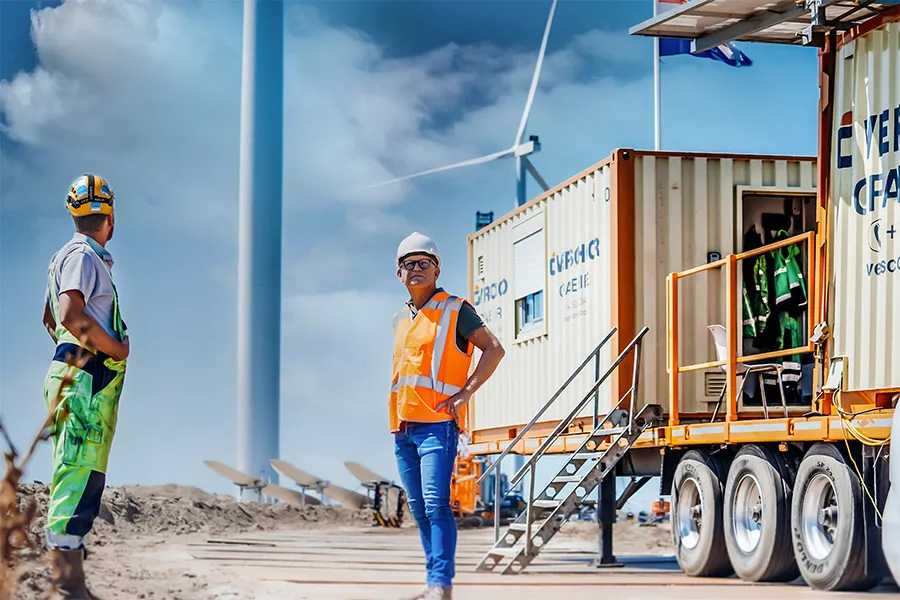
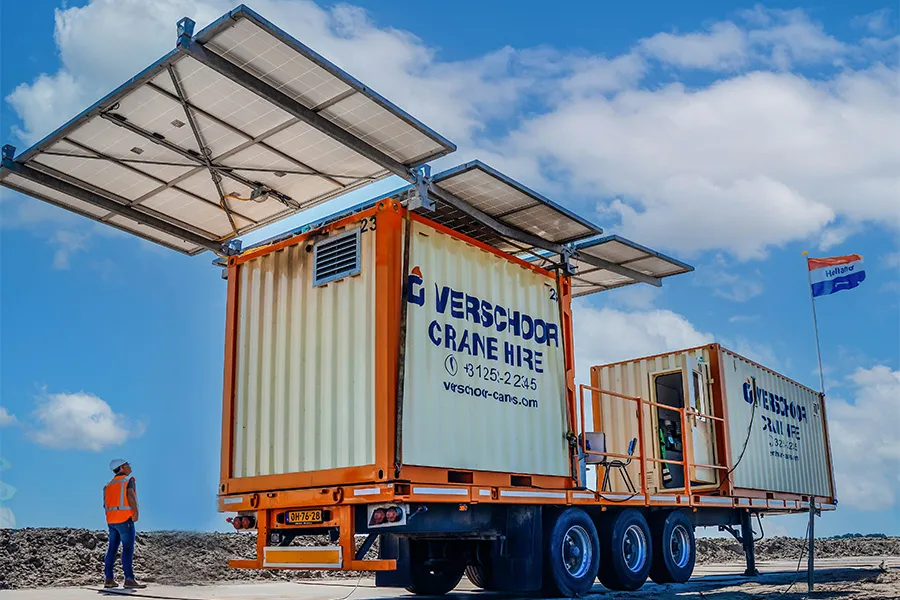
M. Verschoor B.V., a specialist in horizontal and vertical crane transport, is an enthusiastic user of the PowerBlock energy systems. “We now own four PowerBlock systems, each with twelve solar panels producing a total of 4,500 Wp,” says crane operator Robin Bogaers. “Two systems are at the Windplan Groen project, which is set to become one of the largest wind farms in the Netherlands, with ninety wind turbines and a capacity of 300-400 MW. The PowerBlock systems are positioned behind our six-metre-long site welfare unit, where we eat, drink coffee and charge our walkie-talkies.” In the past, he says, the welfare unit was powered by a generator. “But it easily used two hundred litres of diesel a week.
That is an undesirable situation on a green project such as a wind farm!” The PowerBlock energy systems are changing this. “In the summer months in particular, the solar panels and batteries are enough to meet our electricity needs. The generator then serves only as a backup and to handle peak demand.”
As well as reducing diesel consumption, Bogaers is very impressed by the low noise levels of the PowerBlock systems. “This makes working much more comfortable,” he says. “It is a very quiet system, and it looks smart too. We have already received many compliments from our construction partners.”
Compact outdoor cabinet
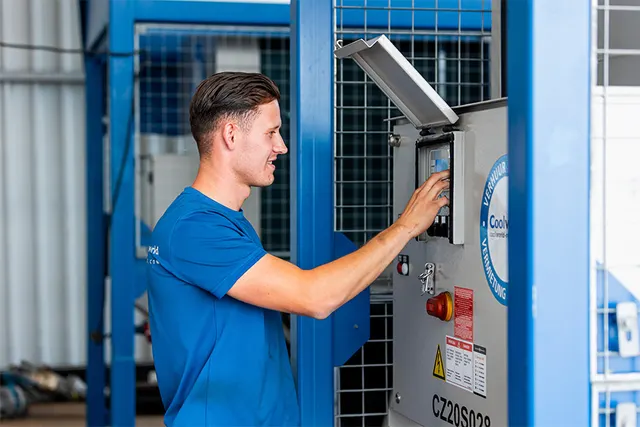
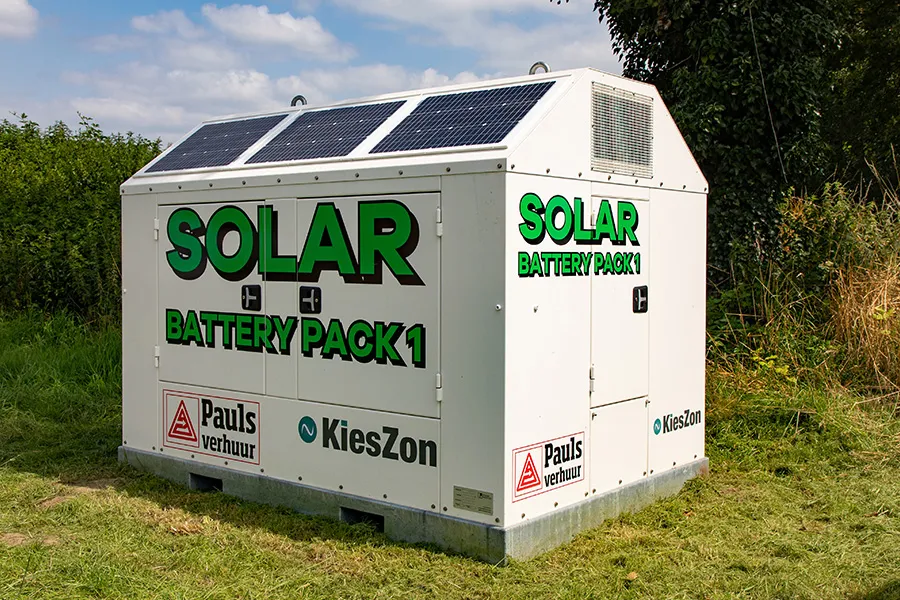
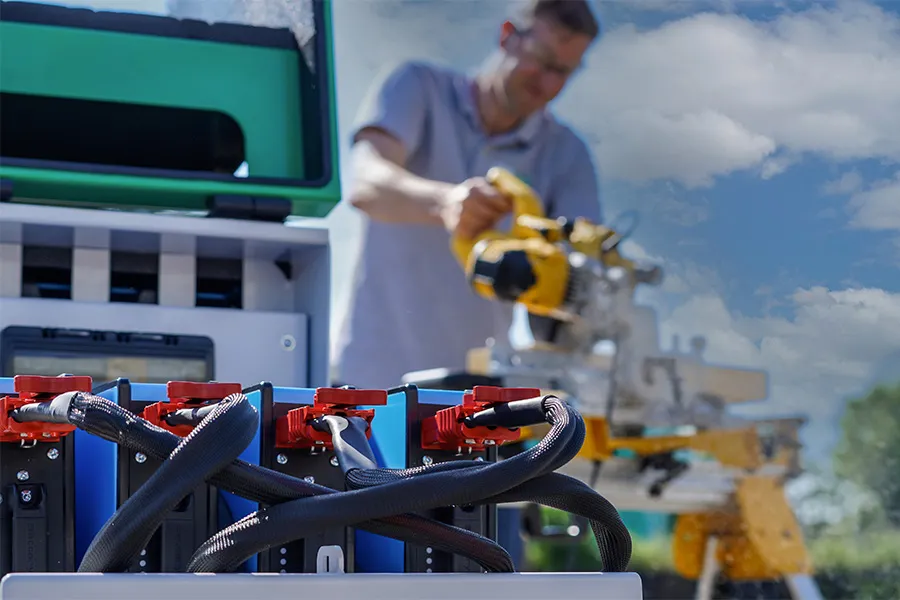
For companies looking for a more compact energy system, Top Systems offers the PowerCube. This energy system is similar to the PowerBlock, but comes in a compact, powder-coated steel enclosure with a galvanised base tray. This prevents corrosion and rust, says Van den Berg. “A small heater, fan and louvred vents keep the energy system at exactly the right temperature and prevent condensation forming inside the cabinet.” The PowerCube is a modular, sustainable, standalone 15 kVA energy system with a battery capacity of 47 kWh. “The system is particularly suitable for charging small electric equipment. Large push-buttons make it easy to operate, while forklift pockets ensure quick and easy positioning on site.” The PowerCube has an integrated Power Management System (PMS) and can be operated and configured via the dashboard touchscreen or over the internet (GSM connection).
Hybrid functionality
The PowerCube can also be used to upgrade generators to hybrid systems. “The PMS ensures that the generator operates under load in its most efficient power range.” The required power is supplied at the outputs, while the remaining capacity is used to charge the battery pack. “If demand exceeds the generator’s capacity, the energy system supplies additional power from the battery pack,” explains Van den Berg. “Once the battery pack is full, and demand is not too high, the connected generator also receives an automatic stop command and the PowerCube takes over the power supply. If demand becomes too high or the battery pack runs low, a start command is sent again. This brings sustainability and reliable operation together perfectly.” A small battery charger keeps the generator’s starter battery continuously charged. “This prevents the battery from running flat.”
Emergency power and peak shaving
Like the PowerBlock, the PowerCube can also be used for emergency power and peak shaving. “It is also interesting that two or three energy systems can be linked, providing even more power and battery capacity,” Van den Berg emphasises.
Mobile energy cart
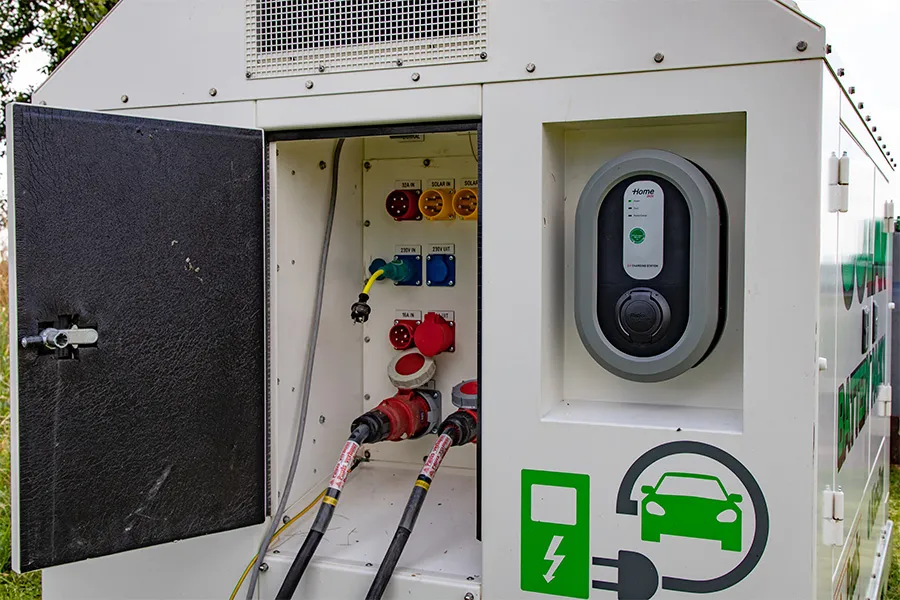
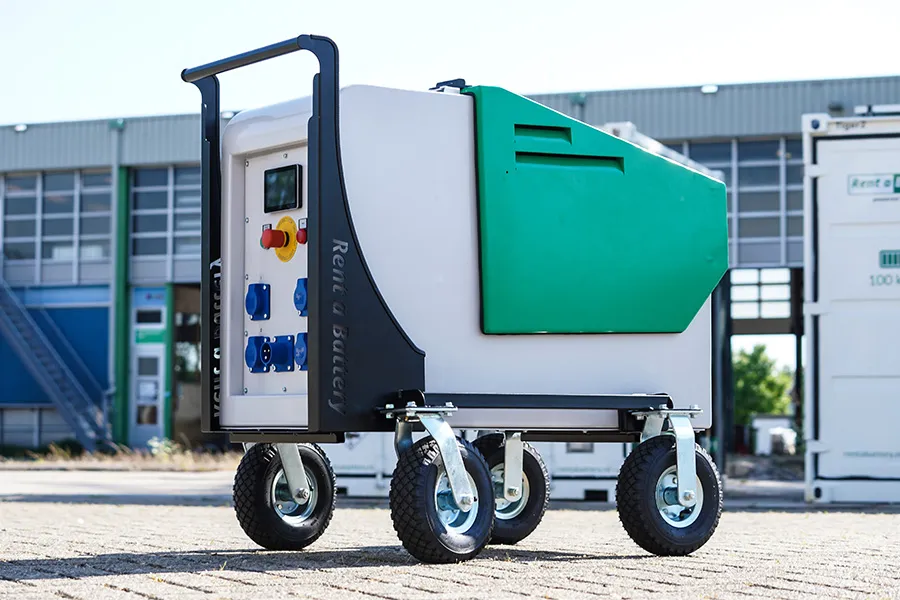
Another useful solution for construction sites is the energy cart, developed and built on behalf of Rent a Battery. The cart has wheels, so it can easily be moved to the right spot on site. “A major advantage of this system is its interchangeable Li-Swap Li-on batteries, which ensure that site workers always have enough power, wherever they are.” Each energy cart is equipped with four handy Li-Swap batteries, each with a storage capacity of around 5.7-9 kWh. “At just 10.2 kg each, and with a handle and Anderson connector, the batteries are very easy to swap.” The batteries connect to a Li-Swap battery pre-charge box, which is also linked to a Victron MultiPlus 48/5000 inverter/charger. This enables a continuous supply of 4,000 W to all connected loads, says Van den Berg. “The pre-charge box prevents sparking when batteries are swapped.” The standard quotation includes four separate battery chargers (48 V/5A) for charging the batteries externally. “All the batteries can be easily monitored via an app, while a CAN-bus communications protocol and Bluetooth connection ensure optimal connectivity. This means we can offer a suitable solution for every construction site and every charging requirement.”
A business enquiry for Top Systems B.V.? Get in touch
Companies in this story

Keep following this
Get an email when a new story is published. No account needed.
- SubjectYearbook
- CompanyTop Systems B.V.
- CompanySolar