Optimum performance, long service life
Text Lieke BousemaImage Spirotech
The importance of pressurisation units and expansion vessels in closed systems
Closed, pressurised heating and cooling systems always need an expansion system to accommodate the expansion of the medium as it heats up or cools down. “If pressure does not build up optimally in the installation, this can adversely affect the performance and service life of the entire system,” says Martijn Worst, Area Sales Manager Utilities & Industry at Spirotech. “That is why it is important to invest in a high-quality expansion system, precisely tailored to users’ heating and cooling needs and which also prevents corrosion.”
Primarily, closed expansion systems are a safety measure for systems that use water as a heat-transfer medium to carry heating and/or cooling energy to a living or working space. In addition, an expansion vessel helps improve the efficiency and reliability of an installation by ensuring that system components operate and are protected optimally.
Risk of corrosion
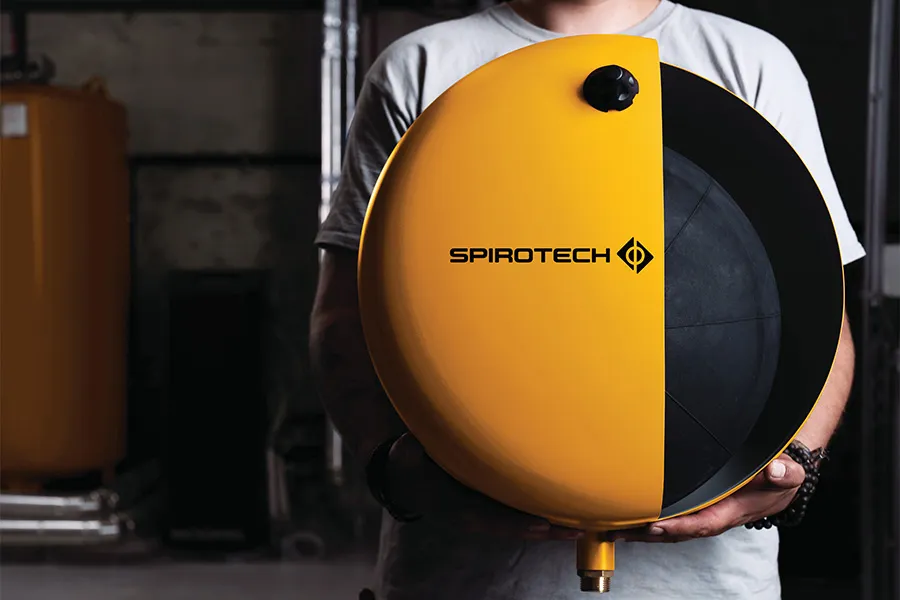
A standard expansion vessel consists of two chambers separated by a rubber diaphragm. The system water is on one side of the diaphragm and a gas with a predetermined pre-charge pressure on the other, explains Worst. “The disadvantage of this type of expansion vessel is that the system water is always in contact with the steel interior of the vessel. The oxygen in the system water can cause corrosion, which can damage the installation.”
Special bladder
For this reason, Spirotech expansion vessels use not a standard diaphragm but a bladder, or bag diaphragm, made from high-quality butyl rubber. It has a long service life and fully contains the system water. “This prevents oxygen-rich system water from coming into contact with the vessel’s sheet-steel wall,” says Worst. “This effectively mitigates the risk of corrosion. Spirotech vessels also offer a wide range of suspension and installation options, providing a suitable solution for every space and situation.”
A solution for every installation
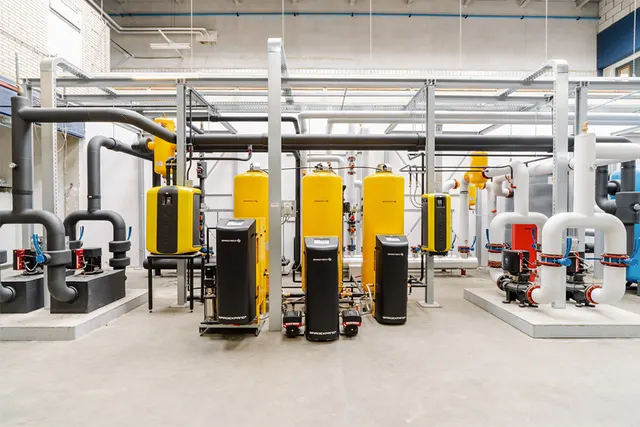
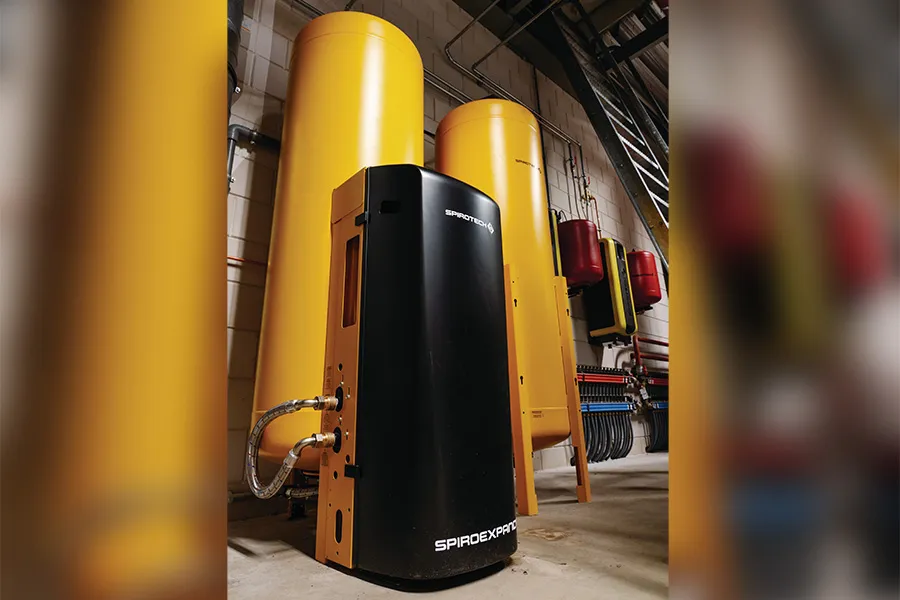
Under the SpiroExpand name, Spirotech offers a wide range of expansion vessels, pressurisation units and accessories for closed heating and cooling systems. The range covers everything from simple solutions to the most complex systems, with maximum operating pressures of 1 to 25 bar and volumes from 4 up to 10,000 litres (larger sizes are available on request).
Pressurisation units
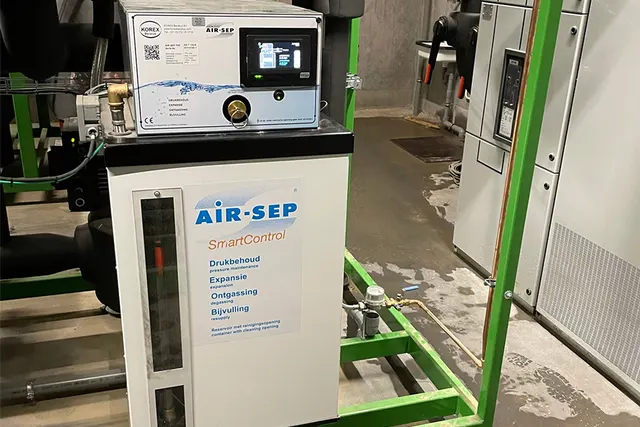
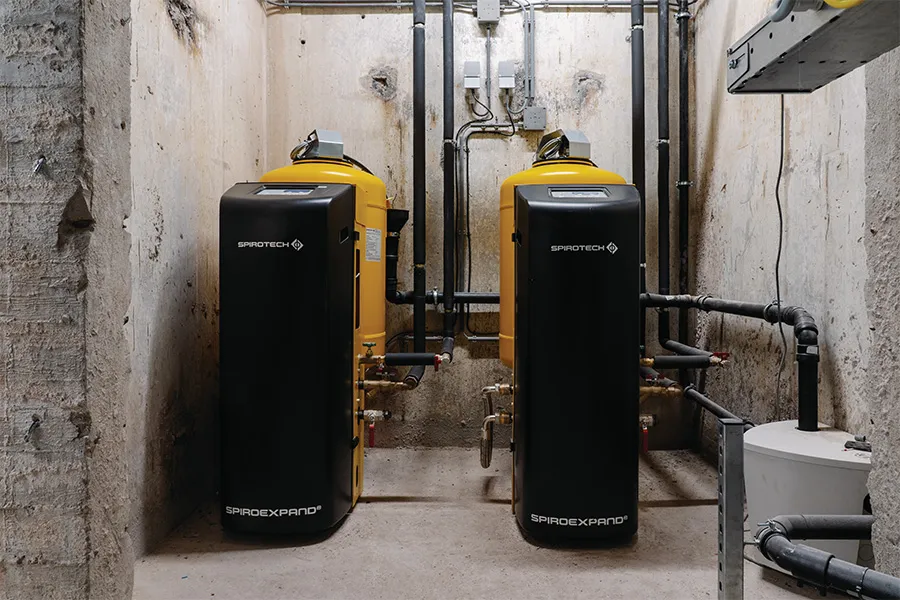
For larger, more complex heating or cooling systems with significant pressure differences, Spirotech recommends using a pressurisation unit, also known as a pressure maintenance system, to regulate pressure. “The main difference between an expansion vessel and a pressurisation unit is that an expansion vessel is a separate component in the system, whereas a pressurisation unit is a complete system comprising multiple components,” says Worst. “Our pressurisation units are designed to maintain constant system pressure, regardless of any temperature fluctuations. This enables the expansion system to ensure the safe and efficient operation of the entire heating or cooling system. Because we use pump-controlled units, the pressurisation unit can be made more compact and integrated more easily into the plant room. This is ideal for projects where floor space needs to be used as efficiently as possible.”
Precise and safe
A pump-controlled pressurisation unit is more accurate than a compressor-controlled unit, says Worst. “Because our systems are built on a fully modular basis, they can be installed on a plug & play
basis, both hydraulically and electrically, which keeps installation time relatively short.” A mechanical valve regulates the pressure in the system. “One innovation here is that we use spring-loaded rather than electrically actuated valves, so the installation continues operating even in the event of a power failure. This safeguards system safety.”
Optimum water quality
The pressurisation unit can be readily connected to the Spirotech vacuum degasser, which controls vacuum degassing of the system water as well as maintaining the correct pressure and replenishing the system. This enables Spirotech to ensure optimum water quality.
A business enquiry for Spirotech? Get in touch
Companies in this story

Keep following this
Get an email when a new story is published. No account needed.
- SubjectWater treatment
- CompanySpirotech