The benefits of a light vacuum
Text Lieke BousemaImage KOREX Benelux
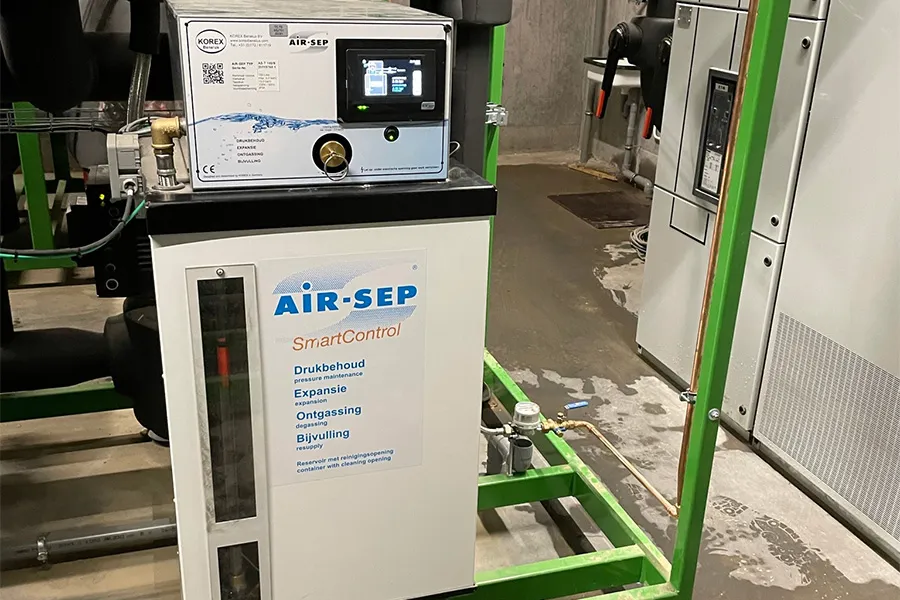
Oxygen in Closed-Circuit Pressurised (CCP) heating, cooling and refrigeration systems can cause corrosion, contamination and loss of efficiency. “To eliminate the risk of these problems, it is important to vacuum and degas the system water correctly,” says Mario van Gorsel, director of KOREX Benelux. “For example, to remove air and gases from the system water.” While most manufacturers opt for deep vacuuming, KOREX Benelux deliberately uses a very light vacuum. In this article, Van Gorsel explains why.
“When you vacuum water, and therefore place it in an environment where the air pressure is greatly reduced, something interesting happens,” he explains. “The boiling point of water depends on the pressure.”
1. A drop in the boiling point
At normal atmospheric pressure (approximately 1,013 mbar), water boils at 100°C. “When you lower the pressure, the boiling point drops dramatically. For example, at -23 mbar, water boils at around 20°C (that is, at room temperature!). At even lower pressures, water can boil at 0°C or below.”
2. Boiling/evaporation begins immediately
“If the vacuum is strong enough, the water will start boiling spontaneously at room temperature, even without any additional heat being applied. This is called flash boiling: the water molecules escape because the vapour pressure of the water becomes higher than the ambient pressure.”
3. Cooling and possible freezing
As it boils, the water absorbs a great deal of heat (the latent heat of vaporisation), causing the remaining liquid to cool significantly. “As a result, the remaining water can even freeze, despite being in a vacuum chamber.”
4. The water eventually disappears
“If the vacuum is maintained for long enough, the water can evaporate or sublime completely (turn directly from ice into vapour), until almost nothing remains. Water under vacuum can therefore boil and freeze at the same time, depending on how strong a vacuum you create!”
Physicochemical changes
“When you degas water, you remove dissolved gases (such as oxygen (O²), nitrogen (N²), carbon dioxide/CO2 and sometimes traces of other gases) from it,” says Van Gorsel. “This can be done using various methods, such as applying a vacuum, heating/boiling or aerating with an inert gas (e.g. nitrogen or argon).” Depending on the gas and the situation, the following physicochemical changes occur:
1. Removal of dissolved gases
Dissolved oxygen, nitrogen and carbon dioxide diffuse out of the water. This lowers the gas pressure in the water and moves it further from saturation.
2. Change in pH
When CO2 is removed, the equilibrium shifts from H²CO3 (carbonic acid) towards less acidic forms, raising the pH and reducing the corrosion potential (the water becomes more alkaline). In fully distilled or demineralised water, the pH can rise from 5.5 (due to dissolved CO2) to almost neutral (7) or even slightly higher.
3. Reduced corrosion potential
Removing oxygen reduces the tendency for oxidation (corrosion) on metal surfaces.
Counterproductive effect
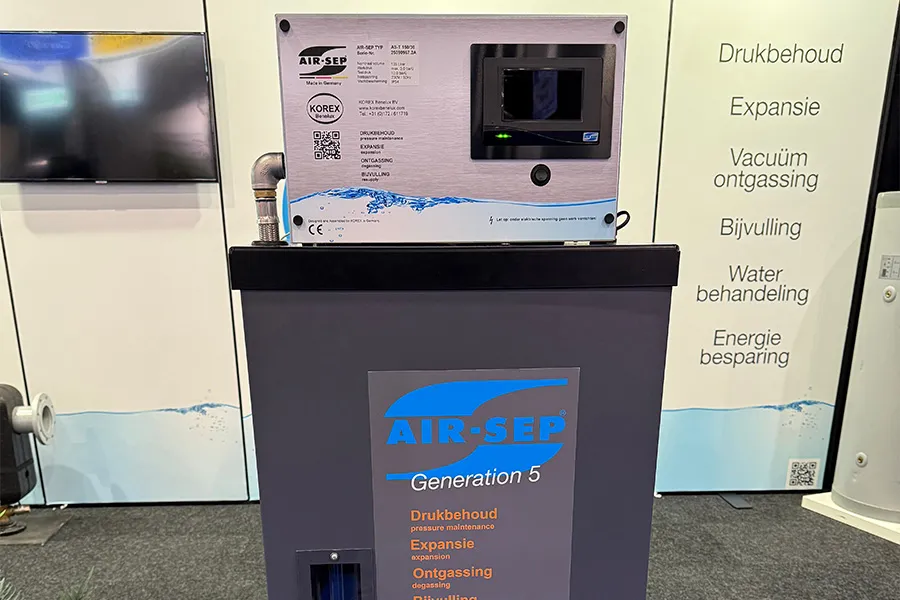
Most manufacturers opt to vacuum and degas water very deeply, says Van Gorsel. “The expansion unit then pressurises a bellows, causing the smallest molecules, such as oxygen, to be absorbed into the system water first. This therefore has the opposite effect. The AIR-SEP® works quite differently. It uses a much lighter vacuum, more gently and on a larger volume. Since vacuuming and expansion are controlled in a single unit, the ‘law of communicating vessels’ also applies to the fullest extent. The pressure in the tank water means that only minimal partial pressure occurs between the oxygen molecules and the atmosphere. As a result, almost no oxygen transfer takes place, improving the quality of the system water, keeping the pH at an optimum level and minimising corrosion, contamination and losses in efficiency.”
New: AIR-SEP® 5.0
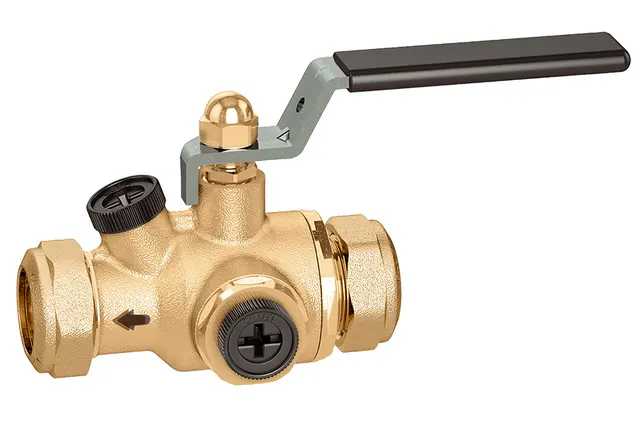
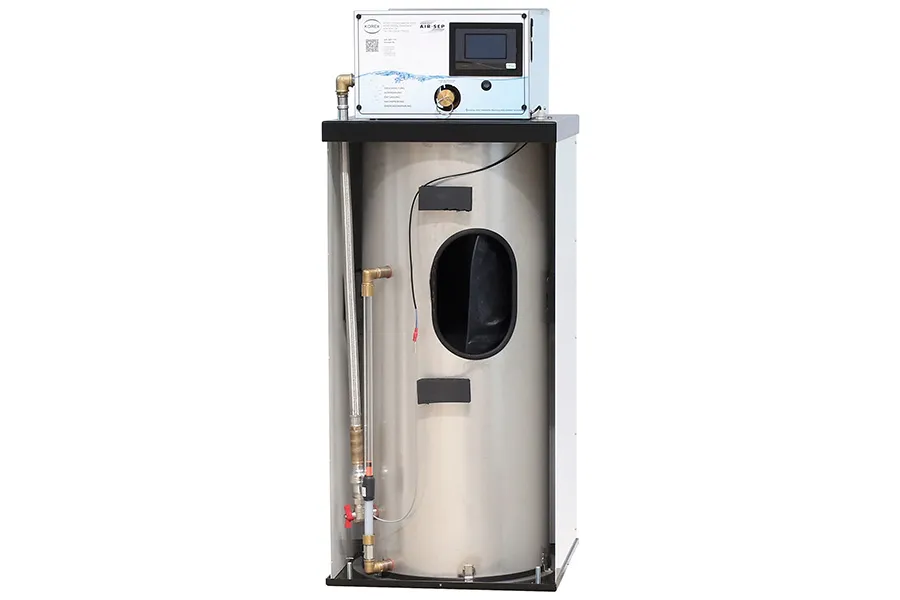
KOREX Benelux uses AIR-SEP® pressurisation units to vacuum and degas Closed-Circuit Pressurised (CCP) heating, cooling and refrigeration systems. The latest version is now being launched: the AIR-SEP® 5.0, whose expansion valve is automated in a highly reliable way. “It uses a ball valve controlled between 4 and 20 milliamps,” says Van Gorsel. “If the power fails or a fault occurs, the ball valve automatically and immediately shuts off the AIR-SEP®. This prevents the system from draining. This is particularly useful for large, high-pressure systems. Recent tests have also demonstrated the success of the electronic expansion valve in smaller systems, where pressure fluctuations are significantly lower.”
Maintaining negative pressure
Like its predecessor, the AIR-SEP® 5.0 features a high-quality 1.6 mm-thick bitumen vacuum membrane (DIN-EN 13831), which guarantees a light vacuum and a fully sealed system. This completely separates the system water from the atmosphere. “The vacuum membrane opens fully automatically as soon as the negative pressure in the expansion and degassing tank becomes too high. This maintains the negative pressure in the tank. Atmospheric air cannot come into contact with the system water in any way, making degassing even more efficient.”
Een zakelijke vraag aan KOREX Benelux? Get in touch
Companies in this story

Keep following this
Get an email when a new story is published. No account needed.
- SubjectWater treatment
- CompanyKOREX Benelux